

A clear buying guide to help you choose a handpan that suits the way you play. This article briefly explains the differences between three material types and how they affect playing.
Two common options affect sustain, projection and touch sensitivity. Stainless steel often provides long sustain and needs less frequent maintenance. Nitrided steel gives a more percussive attack and requires more care.
We also cover Ember Steel, an optimized type of stainless steel that costs more and may come with a waiting list. This overview helps you balance quality, budget and intended use: percussive playing, meditative practice or concerts.
Next, you will find practical criteria, quick comparisons, price ranges and care advice. By the end, you will have a simple approach to a confident purchase and a choice that suits you as a musician.
Why the Metal Makes Such a Difference to Your Handpan
The material directly affects the instrument’s attack, sustain and harmonic balance. DC04-based nitrided steel produces a lively attack and short sustain, ideal for fast patterns and outdoor settings.
By contrast, AISI 430 and 441 stainless steels offer long sustain and bright notes. This supports melodic phrasing and held notes, with greater touch sensitivity.
Background and Trends in France
Since the 2010s, handpan makers have improved their production methods. Their services now include rentals, warranties and retuning, making the instrument more accessible to a variety of players.
Availability is improving, but some special editions still have waiting lists. Compare recordings of the same model in different materials and decide what matters most to you—playing response, sustain or maintenance—before buying.
To learn more about materials and construction, see this dedicated page.
Key Criteria for Choosing the Right Metal
The material determines each note’s attack, sustain and projection.
Sustain, projection and touch sensitivity
Test how several notes respond to your touch. Play indoors, in a studio and then outside. Notice whether the notes ring on or fade quickly. This will help you choose for the settings in which you play.
Maintenance, Rust Resistance and Long-Term Stability
A surface-treated instrument needs frequent care—weekly care is recommended—to prevent corrosion where it has been scratched.
Stainless varieties need less maintenance, generally every 2 to 4 weeks, and less vigilance. Avoid leaving any model in the sun for extended periods.
Price, Availability and After-Sales Service
Overall, the final cost is often similar: depending on the maker, a cheaper base material may be offset by the cost of treatment.
- Availability: standard versions are often available quickly; special editions are limited.
- Services: warranties often last 2 years; local retuning and rental or exchange options are useful in France.
- Practical tip: during a trial, check how long each note rings and how many notes the instrument has. The more notes it has, the more important sustain control becomes.
Final choice: if you favor percussive playing and outdoor use, look for responsiveness. For versatility with less maintenance, favor longer sustain. For extended washes of sound, consider optimized varieties.
To explore what makes a quality instrument and compare your options, read this article on quality and selection.
A Closer Look at Nitrided Steel: Percussive and Responsive
The process begins with a sheet of DC04 steel that is cold-rolled before nitrogen diffuses into it, creating a hardened surface layer. This treatment produces a highly responsive shell with focused resonance.
The Process, DC04 Steel and Its Mechanical Effects
The hardened surface increases sensitivity to strikes. Mechanically, the treated surface vibrates for less time, reducing sustain and concentrating the sound energy.
Benefits for Fast Playing and Outdoor Use
The result suits percussive playing: notes remain clear without overlapping. Drummers looking for a distinct attack, for example, often appreciate this response.
Limitations: Maintenance and Vulnerable Areas
The layer is only at the surface. If it is damaged, the exposed steel can rust. Weekly maintenance—wiping and oiling—is recommended.
The price is often mid-range because nitriding costs offset savings on the base material. In short, this is a good choice if rhythmic clarity and outdoor projection matter most to you.
A Closer Look at Stainless Steel: Versatility and Easier Care
AISI 430 and 441 varieties offer a strong balance between corrosion resistance and ease of shaping during hammering. These grades make tuning easier and reduce the need for extensive adjustments.
AISI 430 and 441: Why Makers Choose These Grades
AISI 430, which contains about 18% chromium and no nickel, and AISI 441 are valued for their resistance to moisture and ease of shaping. They can be hammered and tuned without deforming excessively.
Longer Sustain, Bright Notes and a Sensitive Touch
The sound emphasizes brightness and clarity. Longer sustain brings out sustained textures and harmonic resonance.
Beginners, Well-Being and Meditative Practice
Practical tip: this type suits beginners, yoga and sound healing. Care is straightforward: wipe it after playing and oil it every 2 to 4 weeks.
- Advantage: less frequent maintenance and a rewarding sound.
- Caution: in salty or very humid environments, regular care helps prevent rust.
- Cost: comparable to the other options; the main difference is the sound.
Where Does Ember Steel Fit In?
Introduced around 2020, Ember Steel aims for a warm sound and sustain suited to very slow tempos. This type of stainless steel is designed to extend sustained textures and enrich the harmonics.
Technique: production requires additional temperatures and steps. Treatment takes longer and tuning is more demanding, driving up the price—often to nearly twice that of a standard version.
Recommended use: Ember Steel suits slow practices such as meditation and sound healing. In fast passages, however, its resonance can become overwhelming if the player does not control it with their hand.
Availability and Lead Times
Demand often exceeds supply. Some makers may announce waiting lists of up to 18 months. This is an important consideration depending on how much time you are willing to wait.
“You can hear the differences from the first A/B comparison with standard stainless steel of comparable quality.”
In short, Ember Steel is for players seeking even longer sustain and a warmer sound. If maximum sustain matters to you and you can wait, explore this option in a dedicated guide such as Ember Steel: characteristics and lead times.
Stainless or Nitrided Steel: Which Metal for Your Handpan?
To decide quickly, compare sustain, maintenance, price and availability at a glance.
Quick Comparison: Sustain, Maintenance, Price and Availability
Nitrided steel = lively attack and short sustain. Ideal for outdoor projection and fast patterns. It needs regular care: weekly wiping and oiling are recommended. The price is mid-range and often similar to stainless versions.
Stainless steel (AISI 430 and 441) = long sustain, bright notes and a sensitive touch. Maintenance is less frequent, generally every 2 to 4 weeks. Its price is comparable to nitrided steel, but its sound favors sustained textures and melodic playing.
Ember Steel = very long sustained textures and rich harmonics. Sound quality is high, the price can be twice as much, and the wait can reach 12 to 18 months.
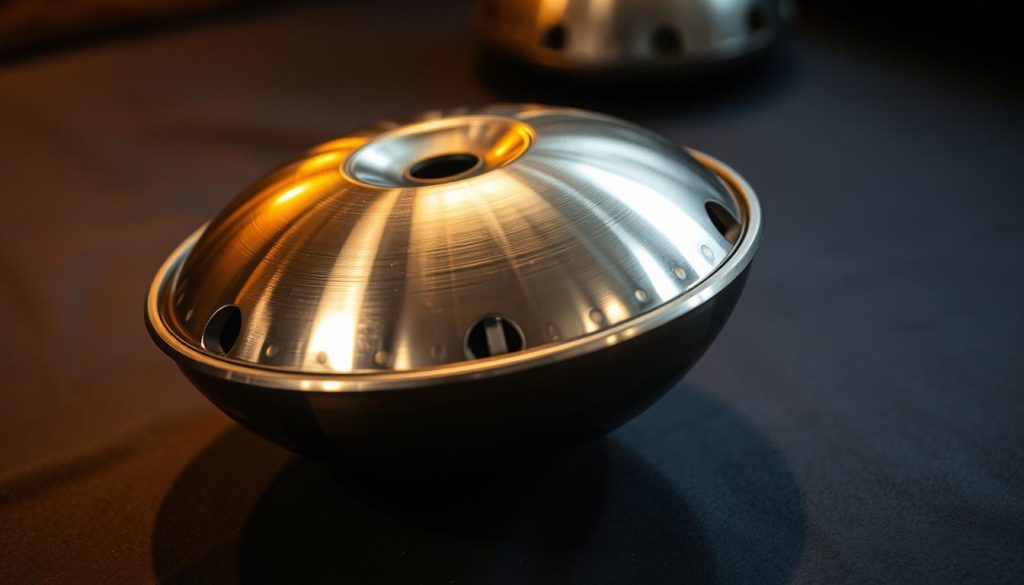
Quick Questions to Match Your Needs
- Do I need each note to fade quickly? Yes → nitrided steel.
- Do I want sustained textures and a pleasantly bright sound? No → stainless steel or Ember.
- Do I have little time for maintenance? Choose stainless steel.
- Is my budget tight, and do I need an instrument immediately? Choose nitrided steel or standard stainless steel.
- Am I looking for extended textures, and am I willing to wait? Choose Ember Steel.
“The longer the sustain, the more important it is to manage the handpan’s notes as you play.”
Quick tip: make your choice in this order: intended use → tolerance for maintenance → lead time and price → side-by-side listening to the same notes. This grounds your decision in the sound you hear and how you will actually use the instrument.
Which Metal Suits Each Type of Player?
Your choice of material depends above all on your playing style and intended repertoire. Each type affects attack, sustain and control over transitions.
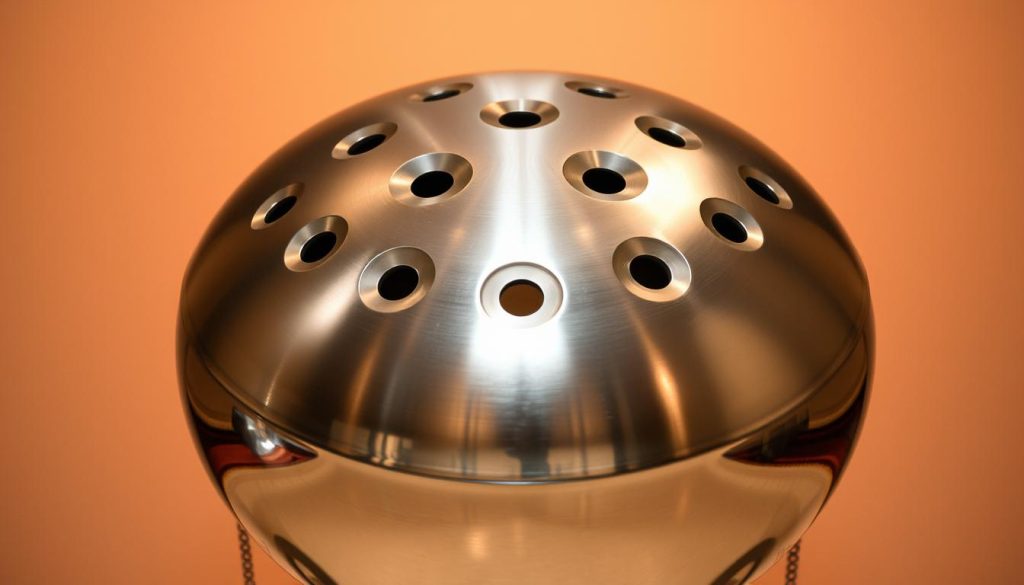
Beginners, Teaching and Progression
Advice: steer beginners toward a forgiving version. Easy care and a rewarding sound make playing and learning more enjoyable.
It also leaves more room to improve: you can hear your progress quickly without struggling with excessive sustain.
Percussionists and Fast Players
Players with a percussion background tend to favor a clear attack and controlled projection. Nitrided steel, with its short sustain, responds well to fast patterns.
Example: play the same sixteenth-note pattern on two different instruments. You will feel the difference in hand articulation and in how you release the notes.
Slow Practice, Meditation and Sound Healing
For yoga and sound healing, look for long sustain and rich harmonics. Longer-sustaining varieties support washes of sound and warm notes.
Selection tip: choose a scale that suits your repertoire. Before buying, listen to demonstrations by players whose style resembles yours.
“Beginners → stainless; percussive players → nitrided; meditative players → stainless or Ember.”
Maintenance, Rust and Real-World Durability by Material
A few simple habits prevent rust and help preserve tuning for longer. A quick step after every session is enough to limit wear. Wipe the instrument with a soft cloth to remove sweat and residue.
Oiling Frequency and Cleaning After Every Session
Suggested oiling interval: every 2 to 4 weeks, depending on use and material. Increase the frequency for untreated versions.
Heat, Humidity and Transport: Good Practices
Avoid prolonged exposure to sunlight. Heat can cause temporary tuning changes. Dry the instrument immediately if it gets wet.
Remove rings and watches before playing, and do not use mallets. Scratches can be especially damaging to surface-treated instruments.
| Action | Frequency | Effect |
|---|---|---|
| Wipe after each session | After every use | Reduces rust and fingerprints |
| Light oiling | Every 2 to 4 weeks | Protects against corrosion and wear |
| Check for scratches | After transport or a fall | Allows prompt treatment to prevent corrosion |
| Transport | Whenever you travel with it | Soft bag for convenience, hard case for protection |
In summary: proper care preserves the tone and extends the instrument’s life. Stainless steel resists rust better, but it is not immune. Paying regular attention to weather and playing conditions helps limit the need for retuning.
Budget, Availability and Maker Services
Before buying, check the maker’s price, lead times and after-sales service.
Quick price guide: expect to pay about €1,000 to €2,000 for a 9-note model from a trusted maker. Models with 10 or more notes are more likely to cost €1,300 to €3,500, or even more.
Price Levels, Lead Times and Waiting Lists
More elaborate editions cost more: some varieties can cost nearly twice as much as standard versions.
| Type | Notes | Indicative price | Availability |
|---|---|---|---|
| Standard | 9 | €1,000 to €2,000 | Quick delivery |
| Extended | 10 or more | €1,300 to €3,500 or more | Varies |
| Premium edition | 9 to 10 or more | About twice the price of standard versions | Waiting lists of up to 18 months |
Rentals, Warranties and Retuning
In France, renting lets you try an instrument before buying. Look for a 2-year warranty, a return policy of 14 to 30 days and local retuning options.
Compare several handpan makers: transparency, after-sales service and audio demonstrations are essential.
Tip: include the case, maintenance supplies and shipping in your budget. The model—9 notes or 10 or more—often affects the cost more than the material itself.
Musical Compatibility: 440 Hz or 432 Hz
The reference pitch you choose affects playing with other musicians. Most modern instruments are tuned to 440 Hz. This makes group playing and rehearsals much easier.
432 Hz remains popular for solo playing, meditation and sound healing. However, this tuning quickly becomes incompatible with a piano or guitar tuned to the standard reference pitch.
Playing Solo or in a Group: Practical Implications
If you play in a group, choose 440 Hz to avoid pitch clashes. For example, a classical guitar and handpan duo needs both instruments tuned to 440 Hz to stay in tune.
Think about the wider musical setting: workshops, group classes and ensembles often require the same reference pitch. Make sure your choice does not limit your collaborations.
Reference pitch matters less to the choice of material than to compatibility with other instruments. Several stainless steel models are available in both 440 and 432 Hz, but 440 Hz remains the more common option.
- Advice: decide on the reference pitch before buying.
- Tip: listen to 432 Hz and 440 Hz demonstrations side by side to hear the difference.
“Group playing → 440 Hz. Solo or holistic practice → 432 Hz.”
Note Count, Scales and Their Effect on Metal Choice
The number of notes profoundly changes how you play and manage resonance. A 9-note instrument—8 notes plus the ding—remains the best starting point for most beginners.
The 9-note format balances simplicity and musical range. It makes scales easier to learn and each note easier to control.
Models with 10 or more notes expand your harmonic options. They also require better sustain control and muting techniques.
9 Notes or 10 or More: Controlling Sustain
9 notes = clarity, a lower budget and simpler tuning.
10 or more notes = richer sound, higher cost and more complex tuning. On a long-sustain version, you will need to mute notes frequently.
Major, Minor and Eastern Scales, and Resonance Control
Major: bright and cheerful. Ideal for lively pieces.
Minor: introspective, creating tension and a sense of musical narrative.
Eastern: evocative atmospheres, often used in meditation.
The D minor scale remains popular with beginners because it immediately sounds familiar and rich.
- Listen to several handpan notes in the same scale to hear how the material affects clarity.
- If you play dense patterns on an instrument with 10 or more notes, the shorter sustain of nitrided steel helps keep phrases distinct.
- If you enjoy shimmering resonance and harmonics, stainless steel extends sustained textures but requires you to mute some notes.
“Start with 9 notes, then expand as your needs change: choose your model according to how much sustain you want to manage.”
Conclusion
Conclusion
In summary, here is a method for a successful handpan purchase: first define how you will use it, how much maintenance you are willing to do, your budget and an acceptable wait. Then listen to several models over a few days before deciding.
Sound quality depends as much on the material as on playing skill and note control. Nitrided and stainless steel can both be excellent choices for the right repertoire; Ember Steel offers even longer sustain if your budget and schedule allow it.
Also consider services such as retuning, warranties and rentals, as well as how your playing may develop. To explore the choice of steel type further, compare instruments, listen carefully and buy when all your criteria are met.