
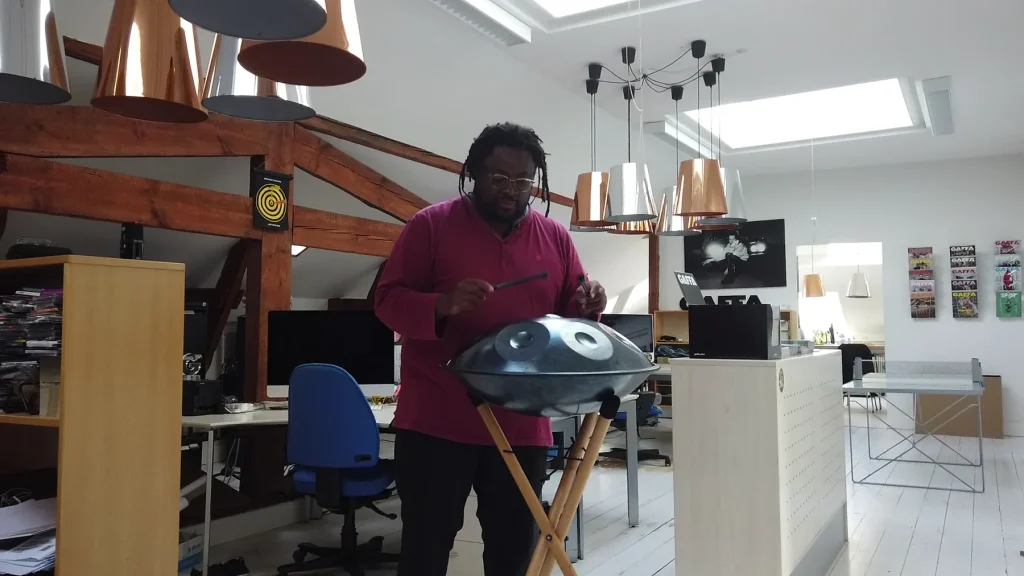
The central question: which instrument best suits the way you play in France today? The choice depends on the sound you want, where you play, and your musical intention.
For playing with a group or in a studio, the modern standard makes it easier to tune with other instruments. For meditation or relaxation, people often prefer a softer, more enveloping sound.
The difference between these two tunings is subtle: the scales and the relationships between notes remain the same, but the experience can vary.
More models and greater variety are available at the standard tuning, making it easier to buy one. Trying both versions remains the best way to choose according to what you hear and feel.
To learn more about relaxation and sound therapy, read this dedicated article: a practical exploration.
Understanding frequency in music and on a handpan (Hz, notes, vibrations)
Frequency is the number of vibrations per second that determines a sound’s pitch. It is the physical measure that gives a vibration its audible pitch.
The higher the frequency, the higher the perceived pitch. Conversely, a lower frequency produces a lower pitch. These variations define an instrument’s notes and range.
Modern concert pitch sets A at 440 Hz, a standard adopted in the twentieth century to bring orchestras into alignment. It makes playing together and tuning instruments easier.
The relationships between intervals remain the same when the same scale is tuned to either 432 or 440 Hz: its harmonic character is preserved. Dissonance can arise when instruments with different tunings are played together.
Without a reference, most listeners cannot identify the exact frequency. They may, however, notice subjective effects, such as softness, warmth or brightness, depending on the tuning.
In the following sections, we will distinguish technical measurements from personal impressions to help you choose.
432 Hz or 440 Hz handpan: which should you choose, and why? A clear comparison
A difference of just 8 Hz in the reference pitch changes the perceived pitch and shifts every note. An A tuned 8 Hz lower sounds lower without changing the intervals between notes.
Technical differences
The relationships between intervals remain the same regardless of tuning. An instrument’s internal stability and relative intonation do not depend on which standard is chosen.
Perception and experience
Many people describe 440 Hz as clear, crisp and bright, while 432 Hz feels warmer and more enveloping. Some people feel more relaxed with the lower-pitched version; others notice no difference.

Musical compatibility
For playing with a group or in a studio, following the modern standard makes it easier to tune with pianos, guitars and wind instruments. For solo or meditative playing, the lower-pitched version may appeal because of its sound.
- Technical: the 8 Hz difference in reference pitch shifts every note.
- Harmony: dissonance is most likely when instruments with different tunings are mixed.
- Advice: try both options in real playing conditions before choosing.
For a guided comparison, see this practical resource: listening and testing guide.
440 Hz: the modern standard, clear notes and versatility for musicians
Adopting a standard A made life easier for musicians and instrument tuners. This compromise emerged amid regional variations ranging from 420 to 460 Hz. The move toward A at 440 Hz began in the nineteenth century and was confirmed internationally in 1953.
History and standardization
Standardization aimed to bring Western music into alignment. For wind and string instruments of the time, this tuning offered effective projection and response without amplification.
Practical advantages
- Compatibility with other instruments, such as guitars and pianos, in rehearsals and studios.
- A wide choice of models and scales, making buying and resale easier.
- Simpler tuning for groups combining different instruments and for improvised sessions.
432 Hz: perceived softness, relaxation and meditative use
In meditative practice, a rounder sound can make it easier to feel immersed and focused.
Sound and vibrations:
Sound and vibrations: a lower, warmer and more enveloping quality
The lower tuning produces a softer, rounder tone. It creates vibrations that many people describe as soothing.
This sound can encourage calm during relaxation and meditation sessions.
Traditions and approaches
In classical music, some historically informed performances use this tuning to reflect regional practices.
Spiritual communities and sound therapy practitioners have also popularized it. It is sometimes called the “heart frequency,” but your ears should guide you.
Many practitioners prefer a solo instrument when focusing on the mind and being present.
Limits and precautions
Compatibility is limited when instruments with different tunings are mixed. Playing with an ensemble tuned to 440 Hz creates pitch differences.
These differences can produce dissonance. For group use, test the instruments together first.
Practical advice: for yoga, sound journeys or intimate listening, an instrument at this tuning often creates an immersive atmosphere. Always try it in a real setting.

| Attribute | Solo use | Group use | Atmosphere |
|---|---|---|---|
| Sound | Low and round | Less compatible | Warm |
| Applications | Meditation, sound therapy | Studio use if the tuning matches | Intimate, contemplative |
| Consideration | Highly musical | Risk of dissonance | Encourages unhurried harmony |
How to choose: use, frequencies, scales and materials
The right instrument depends mainly on how you plan to use it: on stage, in a studio or for personal practice.
To choose, consider your main use, preferred scale, number of notes and material. These factors guide a purchase more than frequency alone.

Playing in an ensemble
To play with other instruments, choose the standard tuning. It avoids differences in intonation and makes group or studio work easier.
Solo playing, meditation and relaxation
For solo practice focused on the body and mind, choose gentle scales such as D Kurd or Amara. They create an enveloping atmosphere for yoga and relaxation.
Scale and instrument
An instrument with 9 to 10 notes suits beginners: it offers enough musical possibilities without being too complex. The scale affects the sound’s character; the choice is personal and depends on your intention.
Availability and budget
Material plays a major role: Ember Steel offers long sustain; stainless and nitrided steel combine durability and balance; and raw steel has a rugged character but needs more care. Reference frequency does not determine the price; the scale, maker and number of notes shape the budget.
| Criterion | Recommendation | Use | Advantage |
|---|---|---|---|
| Tuning | Standard | Ensemble | Compatibility |
| Scale | D Kurd / Amara | Meditation | Enveloping atmosphere |
| Number of notes | 9–10 | Beginner / solo | Musical simplicity |
| Material | Ember / Stainless / Raw | All | Sustain, durability, character |
Practical uses: meditation, concerts, children and travel
Each situation calls for practical choices. Here are clear recommendations for matching the scale, size and tuning to your needs.
Meditation and sleep
For meditation and relaxation, consider D Kurd or Amara with 9 to 10 notes. These scales create a gentle, steady soundscape.
Play at a moderate volume with slow, repetitive patterns. Consider a 432 Hz handpan if that approach to sound appeals to you.
Concerts and varied playing
On stage or in the studio, choose the 440 Hz standard to make it easier for musicians to play and record together.
If you alternate between solo and group playing, 440 Hz offers the greatest compatibility while still allowing intimate performances.
Children and travel
For a child, choose a lightweight model 50 to 55 cm in diameter, with a simple scale (D Kurd or Amara) and 9 to 10 notes. Mini models with 4 to 6 notes are also available for beginners.
For travel, choose a compact model, a sturdy case, and stainless or nitrided steel to reduce corrosion.

- Meditation and sleep: D Kurd or Amara, gentle playing, and a 432 Hz handpan if that approach to sound appeals to you.
- Concerts and studios: 440 Hz is recommended for tuning with other instruments.
- Children: 50 to 55 cm, a sturdy case and an intuitive scale.
- Travel: compact size, stainless or nitrided steel, and protection from moisture.
For help choosing an instrument for your intended use, read this practical guide: which instrument to choose.
Conclusion
Beyond the numbers, what you hear and feel matters most. Standard tuning offers the best compatibility with most instruments and musicians, while the lower tuning appeals to people seeking meditation and relaxation.
Both tunings follow the same internal tuning principles: the relationships between notes remain identical. The risk of dissonance comes mainly from mixing different tunings.
To decide, focus on your main use, the scale (D Kurd or Amara), the number of notes (9 to 10 to start) and the material’s quality. Tuning stability and workmanship matter more than reference frequency for longevity.
Practical advice: try the same scale at both tunings in a quiet setting. There is no universally best option: seek a match between your musical intention, your body and mind, and the setting in which you play.