
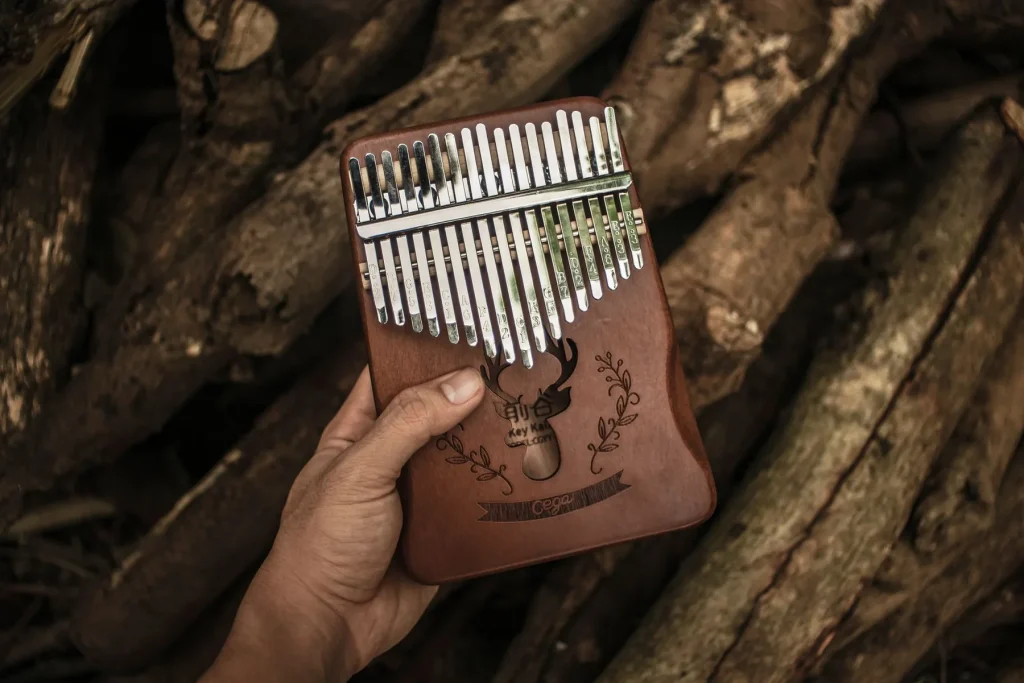
The kalimba is a fascinating instrument that many people know little about. Originally from Africa, it belongs to the idiophone family. This thumb piano offers a unique musical experience worth sharing.
In this article, we invite you to explore everything you need to know about this instrument. We will cover every aspect, from its origins to how to choose one. The author, who has been passionate about this instrument for more than ten years, shares her expertise with you.
You will discover the differences between its various names, how it works, and its benefits. This guide will help you choose the model that suits you best. Its clear, reassuring approach will help even complete beginners feel at ease.
Origins and history of the kalimba
The roots of this fascinating instrument reach deep into history. Archaeological research suggests that it was invented twice in Africa. The earliest traces date back more than 3,000 years on the west coast, in what is now Cameroon. At the time, its tines were made of bamboo.
After a long gap, examples appeared about 1,700 years later near the Zambezi River, which runs through Zambia, Zimbabwe, and Mozambique. These kalimbas, around 1,300 years old, had metal tines, a significant advance in the instrument’s design.
Traditionally, African griots played the kalimba at celebrations and religious gatherings. It accompanied stories and ceremonies, creating an intimate, moving atmosphere.
In the 16th century, Portuguese colonists encountered this instrument in Mozambique. The earliest written accounts are attributed to the missionary João dos Santos, who described an instrument similar to the “ambira,” with nine tines mounted on a wooden support.
The kalimba truly began reaching a wider audience in the 1950s thanks to ethnomusicologist Hugh Tracey. Fascinated by this instrument since his time in Africa, he created a Westernized 15-tine version with a resonator box. He also founded AMI (African Musical Instruments) in 1954.
The name “kalimba” comes from “luba-kasimba,” meaning “thumb piano” in Tantetela, a language spoken in the Democratic Republic of the Congo. Since the 1950s, this instrument has grown considerably in popularity, helped by bands such as Earth, Wind and Fire, who incorporated it into their music.
Kalimba designs continue to evolve today. There are 17-note versions made from materials ranging from wood to acrylic glass. Technological innovations, such as built-in microphones, further enrich the musical experience.
- The kalimba was invented twice in Africa, with traces dating back more than 3,000 years in Cameroon.
- The earliest models were made of wood and bamboo, but disappeared because these materials were fragile.
- More recent kalimbas, around 1,300 years old, were discovered near the Zambezi River with metal tines.
- Traditionally, griots played the kalimba during ceremonies.
- The first written accounts date from the 16th century and are by João dos Santos.
- Hugh Tracey modernized the kalimba in the 1950s, making it accessible to a wider audience.
- The term “kalimba” means “thumb piano” in Tantetela.
- Its popularity has grown sharply since the 1950s, influencing various musical genres.
- Modern models include innovations such as built-in microphones.
To learn more about the origins and evolution of this instrument, read this article on the origins of the kalimba.
What is a kalimba? Definition and description
A kalimba is a percussion instrument in the idiophone family. Idiophones produce sound through the vibration of their own material. With a kalimba, sound is produced when the player presses and releases a steel tine, causing it to vibrate.
This thumb piano has several names, including mbira, sanza, and finger piano. Traditionally, it is made of wood, although acrylic glass and ABS plastic models are also available. Its structure includes a soundboard, which may or may not have a resonator box, fitted with several steel tines.
Two bridges and a metal bar hold the tines under pressure, helping the instrument stay in tune. Each tine produces one musical note, and its length can be adjusted to change its pitch. A kalimba generally has between 8 and 22 tines. Each tine sits above a cavity that acts as a resonator and amplifies the sound.
Here is a summary of the kalimba’s features:
| Feature | Details |
|---|---|
| Type of instrument | Percussion (idiophone) |
| Other names | Mbira, sanza, thumb piano, finger piano |
| Materials | Wood, acrylic glass, ABS plastic |
| Number of tines | Between 8 and 22 |
| Sound production | Tines vibrate after being pressed and released |
| Resonator box | Yes (wood or metal) |
To better understand this instrument, you can watch a video demonstrating the kalimba’s sounds and playing techniques. It will help you appreciate its charm and musical qualities.
To learn more about the kalimba’s features and how to use it, read this article covering everything you need to know about the kalimba.
Kalimba, mbira, sanza, and sansula: What is the difference?
Before the term kalimba became common, this instrument was known by several names. Depending on the region, it was called mbira, sanza, karimba, likembe, mbila, huru, nhare, matepe, njari, okeme, ubo, or gyilgo. These many names reflect the diverse roots of this instrument.
Ethnomusicologist Hugh Tracey chose the word “kalimba” to market his Westernized version. Today, kalimba generally refers to that version, while the other names refer to traditional instruments made in Africa. This distinction highlights the cultural richness of these instruments.
Another instrument worth knowing is the sansula. Invented in 2001 by Peter Hokema, it has a frame drum beneath a conventional kalimba without a resonator box. This provides greater control over the sound’s resonance.
As for grammatical gender in French, most dictionaries treat kalimba and mbira as masculine nouns and sanza as feminine. The Académie française has never examined the matter in depth, so using the feminine form for kalimba is not strictly an error.
To keep the names straight, consult a detailed comparison of the kalimba, mbira, sanza, and sansula. A more comprehensive article also discusses the origins of all these names.
| Name | Type | Characteristics |
|---|---|---|
| Kalimba | Westernized version | Created by Hugh Tracey; a modern version with a resonator box |
| Mbira | Traditional | Used by African peoples and made using longstanding traditions |
| Sanza | Traditional | A feminine noun in French, often used in African contexts |
| Sansula | Modern | Invented in 2001, with a frame drum to control resonance |
How the kalimba works and is made
Making a kalimba starts with a careful choice of materials. Traditionally, this instrument is made of wood. Technological advances have also made acrylic glass and ABS plastic models possible.
Materials used in construction
Mahogany is the most common wood for beginner kalimbas. It produces a rounded, gentle sound with enough sustain for each note to ring clearly.
Well-known makers such as Gecko and Hluru offer mahogany models whose finish and build quality are well suited to a first purchase.
Transparent or colored acrylic kalimbas stand out for their attractive design. They produce a brighter, more crystalline sound, but are often heavier than wooden models.
The choice of carbon steel for the tines also matters. This strong, attractive material helps ensure durability and good sound quality.
The resonator box and its effect on sound
On a “hollow” model, the resonator box amplifies the sound produced by the vibrating tines, giving it a fuller, more enveloping quality. Flat models, by comparison, sound quieter and more intimate, with clear sound that carries less far. They are ideal for playing in quiet places.
The sound hole also allows players to experiment with effects. Partly covering the opening with your fingers boosts the bass, creating an effect reminiscent of a piano soundboard.
This comparison summarizes the differences:
| Type of kalimba | Material | Sound characteristics |
|---|---|---|
| Hollow | Wood (mahogany) | Amplified sound, rich resonance |
| Flat | Wood or acrylic | Clear sound that carries less far |
| Acrylic | Clear or colored acrylic | Bright sound; heavier instrument |
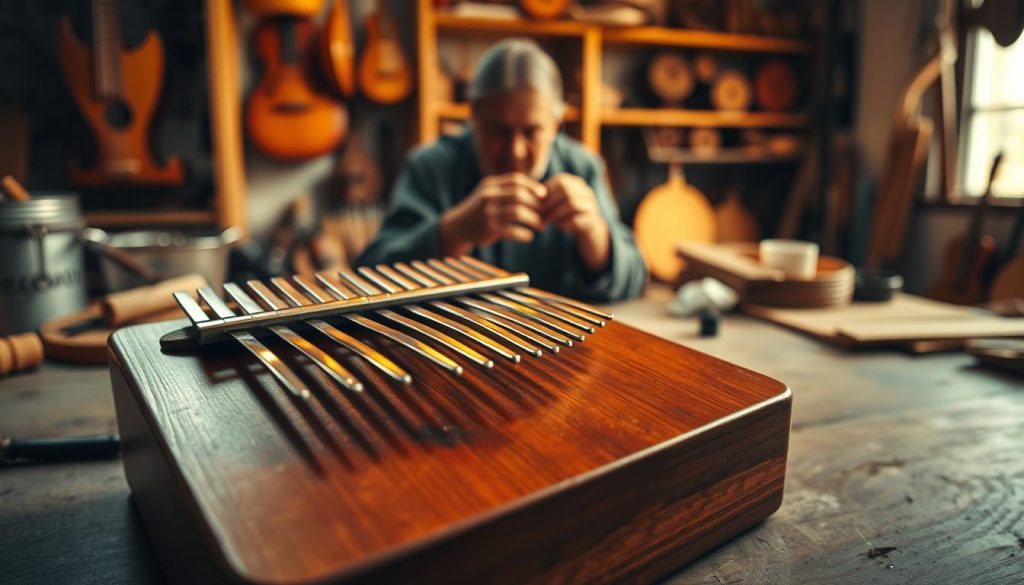
How does a kalimba produce sound?
A kalimba produces sound through a fascinating mechanism. All the tines on this instrument are held under pressure between two bridges. When a player presses a tine and releases it sharply, it vibrates up and down.
These vibrations move the surrounding air and produce the sound we hear. Pitch depends mainly on the length of the tine: the longer it is, the lower the sound; the shorter it is, the higher the note.
The tines’ vibrations pass through the instrument’s soundboard and shape its overall tone. The material used to make the kalimba also affects sound quality. Wood, for example, absorbs and spreads vibrations differently from acrylic.
If the kalimba has a resonator box, it amplifies the vibrations and increases the volume. Some models have two holes on the back, allowing the player to create a vibrato effect by covering and uncovering them at certain points in a melody.
- The tines are held under pressure between two bridges.
- The player’s movement makes the tines vibrate.
- Those vibrations move the air and produce sound.
- The length of a tine determines its pitch.
- The soundboard amplifies the tines’ vibrations.
- The choice of materials affects sound quality.
- The resonator box increases the volume.
- Holes on the back allow more advanced playing techniques.
To understand this process better, watch a video showing the tines vibrating. You will see that the kalimba works simply, making it an instrument anyone can approach.
The kalimba in contemporary music and its famous players
In contemporary music, the kalimba stands out as a distinctive instrument. Although it is not widely used, it has found a place in several genres.
The jazz-funk band Earth, Wind and Fire, founded in 1969, was among the first to incorporate this instrument into its music. Its use of the kalimba paved the way for other artists.
From the 1970s onward, Congolese guitarist Mose Fan Fan began popularizing the kalimba in urban music. Its distinctive sound helped introduce this instrument beyond Africa.
More recently, Elliott Smith also used the kalimba in some of his songs, increasing its appeal among newer generations. Today, people value its gentle sound and ease of learning.
Many musicians, both amateur and professional, are drawn to the kalimba. YouTube tutorials make it easier for beginners to learn to play the kalimba.
With its calming sound and ancient roots, this instrument increasingly attracts Westerners seeking meditative instruments. Once a traditional instrument, it has also become a valued part of contemporary music.
Despite being uncommon on stage, the kalimba has found its place in the musical world. Discovering the artists who use it can broaden your musical knowledge and provide inspiration.
Why learn the kalimba? Benefits and therapeutic use
Learning to play an instrument has many advantages. It improves coordination and fine motor skills. These benefits can be especially valuable for children and older adults, whose coordination may change over time.
Learning an instrument can also strengthen self-confidence and stimulate mental functions, particularly memory. It may help reduce stress and express emotions. With its gentle sound, the kalimba is well suited to enjoying these benefits.
Music therapy is a structured practice overseen by an official French federation. It uses music as part of care. It may be passive, when a patient listens, or active, when the patient plays an instrument.
Creil Hospital offers a practical example of using the kalimba in music therapy with infants. A France 3 report shows how this instrument helps soothe young patients.
Here are some qualities that make the kalimba a popular choice in music therapy:
- Gentle, relaxing sounds that encourage calm.
- A small size and easy portability that help anyone become comfortable with the instrument.
- Simple operation that makes learning quick and accessible.
- Less complexity than other instruments, such as the guitar, which take longer to learn.
These qualities make the kalimba a good choice for anyone who wants to begin making music without too many demands. To explore the subject further, read this article on the benefits of the kalimba.
Playing the kalimba can be a rewarding experience. Whether for enjoyment, relaxation, or therapy, this instrument offers many benefits to those who try it.
| Benefit | Details |
|---|---|
| Better coordination | Strengthens fine motor skills, benefiting children and older adults. |
| Self-confidence | Playing an instrument strengthens self-esteem. |
| Less stress | Calming sounds help release tension. |
| Music therapy | Used in healthcare settings for its beneficial effects. |
| Accessibility | Easy to learn, even for beginners. |
Who is the kalimba suitable for, and at what age?
The kalimba is an instrument for people of all ages. Its light weight and compact size make it an appealing choice for beginners. Some parents even play the mbira during pregnancy, allowing the baby to become familiar with melodies that may later provide reassurance.
In their first months, babies can try making sounds by pressing the tines. It is a simple, enjoyable way to introduce children to music.
For children and teenagers, it is important to match the instrument to their age and musical experience. One practical guideline is to choose a kalimba with roughly as many tines as the child’s age. A ten-year-old, for example, might start with a ten-tine model. The number can be adjusted to suit their musical experience.
For adults and older people, the kalimba is a wonderful learning tool. It offers a way to discover music without a major time commitment. Its simplicity is an advantage: you do not need to spend years studying music theory to enjoy what it can do.
Its light weight and portability also let older people play melodies even if they no longer have the strength they once did. This makes learning and playing accessible in many circumstances.
To learn more about how the kalimba suits different ages, read this article covering everything you need to know about the kalimba.
Is the kalimba easy to play? Methods and learning
Learning the thumb piano is something anyone can try. The simplicity of this instrument lets people explore music with confidence. Each tine produces a single note, as a piano key does, avoiding the difficulty of finding the exact position for a note on an instrument such as a violin.
Thumb pianos often come with useful accessories. These may include sticker sheets to help identify notes, instruction booklets, and sheet music. Silicone thumb protectors are also available and can be useful during long playing sessions.
Simplified notation has made learning music easier. Letters or numbers show the order in which to press the tines, letting beginners start without reading conventional sheet music. More experienced players can also use standard notation.
Most video tutorials, apps, and free online scores are designed for 17-tine models, which makes getting started easier. The symmetrical arrangement of the tines, with low notes in the center and high notes alternating left and right, also helps players find them by sight and touch.
Overall, the kalimba is an instrument that combines accessibility with musical potential. Its simplicity lets even people who lack the time or desire to study music theory play beautiful songs.
How to choose a kalimba for beginners
Choosing a kalimba can seem complicated, especially for a newcomer. Several features are worth considering to make learning enjoyable and effective.
Number of tines and musical scales
For a beginner, a practical range is between 10 and 17 tines. Below ten, a kalimba can feel more like a limited sound toy. Above 17, the greater number of notes makes reading and playing more demanding.
The 17-tine model has become an informal standard for beginners. It offers enough range to play many popular melodies without excessive technical complexity. Most models are tuned to C major, a pleasant-sounding scale.
The tines are arranged symmetrically: low notes sit in the center, while higher notes alternate between the left and right. This helps players find notes quickly.
Materials and comfort
Mahogany is the most common wood for beginners. It is light and produces a rounded, gentle sound with ample sustain. Acrylic models may look more striking, but they are often heavier and more expensive for comparable quality.
Playing comfort matters. It depends on details such as rounded edges, the absence of sharp corners, and a pleasant wood texture under the thumbs. A good beginner model generally costs around €30 to €50. Quality is a better priority than brand name.
In short, a good-quality 17-tine kalimba is a sensible place to start. It lets you build a solid foundation before considering a model with more possibilities.

Essential accessories for getting started with a kalimba
Owning a kalimba without accessories is rather like having a piano without a tuning key or bench. The right accessories help make learning more enjoyable.
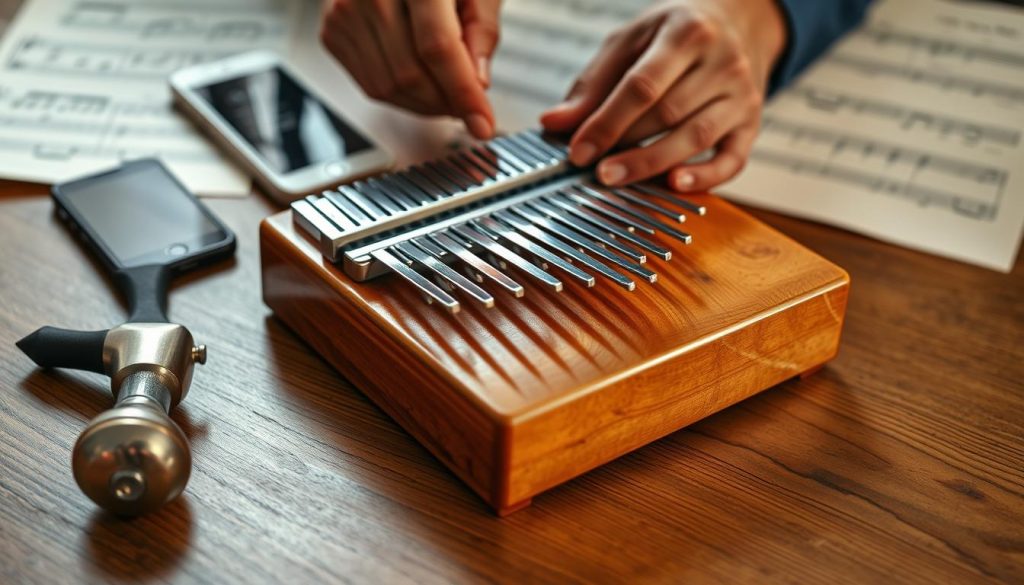
The most useful items include a tuning hammer, stickers for identifying the tines, a good case, and a short booklet. The tuning hammer is essential because tines can shift over time. By gently tapping their bases, you can move them forward or backward to maintain proper tuning.
Note stickers, often small colored labels, help you quickly find C, G, and the other notes. As you improve, you can remove them and rely more on memory.
Some kits include the kalimba, its accessories, and a starter booklet with simplified scores in a dedicated notation system. A good booklet should be clear, avoid jargon, and introduce progressively more challenging pieces. It may also include PDFs or QR codes linking to explanatory videos.
Silicone finger protectors are also worth considering. They can help prevent discomfort during long or intensive sessions. Before buying, check whether these essential accessories are included. Over time, such details can determine whether an instrument stays in its box or becomes a daily companion.
How do you tune a kalimba?
How difficult this instrument is to tune depends on its quality and design. Even if a kalimba arrives in tune, it will gradually drift with use. An instrument played rarely may need tuning once a year, while moderate use may call for a monthly adjustment. Musicians who play loudly for several hours may need to tune it daily.
Beginners should choose a kalimba with standard tuning to avoid unnecessary difficulty. The usual tuning method is fairly simple: gently tap the base of each tine with a tuning hammer to move it forward or backward. This changes the length of the vibrating section and, therefore, the pitch of the note.
Here are the key points to remember about tuning:
- Check the tuning regularly; how often it needs adjustment depends on use.
- Use a tuning hammer to adjust the tines and change their notes.
- You can tune the instrument to different pitches to explore new keys.
- Beginners should avoid complicated adjustments and choose a standard-tuned model.
- Make sure the kalimba comes with instructions to help with tuning.
- An included tuning hammer is a sign that the maker has considered the player’s needs.
For more experienced musicians, changing the instrument’s tuning can open up new sounds. It is still wise to begin with standard tuning while learning the basics. An instruction guide can be very helpful when learning to tune your kalimba properly.
Although tuning may seem intimidating at first, it is fairly straightforward and requires no special expertise. A standard-tuned kalimba with clear instructions will make learning and using this instrument much easier.
| How often tuning may be needed | Use |
|---|---|
| Once a year | Rarely played |
| Once a month | Moderate use |
| Once a day | Intensive use |
Different kalimba models and their uses
Kalimba models vary in their number of tines and other features. There are models with 6, 8, 9, 10, 15, 17, 19, 21, or 24 tines, and even more.
Six-, eight-, and nine-tine kalimbas suit children aged four to seven. These models offer a sensory introduction focused mainly on discovering that pressing a tine with the thumb makes a sound. For adults, they are usually limited to occasional play.
The sound quality and musical range of these small models are limited. They often end up as decorations rather than instruments played regularly.
For music enthusiasts, kalimbas with 19, 21, or even 24 tines offer a wider range that is sometimes chromatic. These models, however, demand careful playing and a good visual memory.
Beginners should be aware that advanced models may suit experienced musicians but are less suitable as a first purchase. Otherwise, they may spend more time searching for the right tine than listening to the sound.
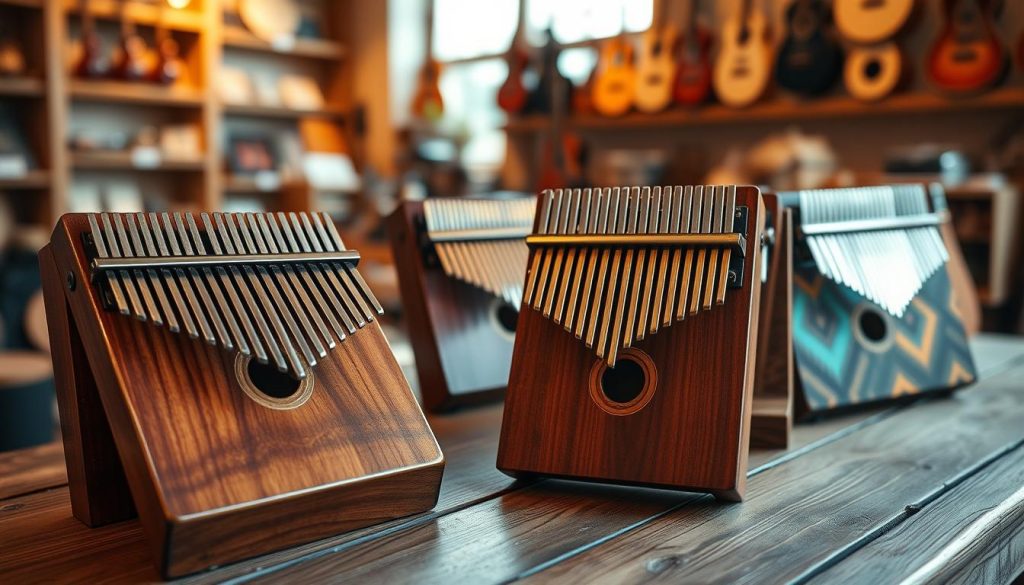
Flat kalimbas are carved from a solid block. Their quieter, more intimate sound makes them useful while traveling, on public transport, or at the office.
Kalimbas with resonator boxes, known as “hollow” models, produce a fuller, more enveloping sound. Players can also create effects by covering the sound hole.
Acrylic kalimbas have a crystalline sound but are often heavier. Mahogany kalimbas remain a popular choice for learning because of their warm, pleasant sound.
Your choice depends on how you intend to use the kalimba: relaxation, musical progress, group playing, or a gift for a child. Each instrument has its own strengths and level of difficulty, so it helps to learn about the options before choosing.
Where can you buy a kalimba in France, and how much does it cost?
More stores now sell kalimbas, both in traditional music shops and on specialist websites. This gives buyers plenty of choice across different budgets.
Prices vary considerably. Entry-level models start at around €20. For a good beginner model, expect to spend between €30 and €50. Professional kalimbas, often supplied with more tines and accessories, can cost over €100.
Very low prices deserve caution, as they can indicate a lower-quality instrument. It is better to prioritize quality over a bargain price. Sites such as Amazon, eBay, and AliExpress can offer deals, especially during flash sales, seasonal sales, or Black Friday.
To keep up with promotions, consider subscribing to sellers’ newsletters. Specialist sites such as thekalimba.com also offer delivery throughout France, Switzerland, and Belgium.
Before buying, compare models and read other customers’ reviews. Consider these factors:
- Number of tines
- Material
- Tuning
- Brand
- Budget
- Included accessories
If possible, listen to the audio samples sellers provide to get a sense of the sound. Trying several models in a shop can also help. Even a beginner can hear differences in sound quality.
Buying a kalimba takes a little research, but it is worth finding one that meets your expectations. Investing in a good kalimba from the outset will make learning easier and help you get the most from this instrument.
| Type of kalimba | Approximate price |
|---|---|
| Basic model | From €20 |
| Good beginner model | €30 to €50 |
| Professional kalimba | Over €100 |
Kalimba: A complete guide to discovering this musical instrument
This small thumb piano, both simple and captivating, appeals to a growing audience. This guide aims to answer every question about this fascinating instrument. The author, an enthusiast for more than ten years, has explored every aspect of its musical world.
As you read, you will learn what a kalimba is, discover its origins, and find out how to choose the model that best meets your needs. You will also discover how to play the mbira and develop the techniques needed to improve.
With this knowledge, the instrument will feel much more familiar. You can confidently choose the model that suits you best. Its growing appeal, particularly among Westerners looking for meditative instruments, shows how much it has to offer.
Accessible to everyone, the kalimba makes it easy to play captivating melodies whether you are a beginner or an experienced musician. With its calming sound and ancient roots, it deserves to be discovered and enjoyed.
So choose a kalimba and start playing today. A rewarding musical experience awaits you.
Conclusion
Accessible and relaxing, this instrument offers a lovely introduction to music. With a little practice, you can enjoy playing captivating melodies. Lessons are not essential, making it an excellent choice for beginners.
When choosing a model, look for a kalimba with 10 to 17 tines, preferably made of mahogany. A resonator box will improve the sound. Remember useful accessories such as a tuning hammer and note stickers to make learning easier.
Finally, take time to compare models and try them before buying. This lets you hear the differences in sound. Whether you are a newcomer or an experienced musician, this instrument can charm you.