

Goal: this guide helps you make the right choice between premium makers and assess a handpan’s quality before buying.
It is for discerning musicians and informed buyers who want to compare instruments without making an expensive mistake.
We cover the key factors: sound, number of notes, scales, materials, budget and potential scams. You will also find practical advice on listening to demos through headphones and trying instruments in a shop or at a festival.
Important: prioritize consistent craftsmanship, after-sales service and the option of retuning. Keep realistic price ranges in mind so you can spot offers that are too good to be true.
This article takes a neutral, practical approach. Take your time, train your ear and compare several models. The conclusion offers recommendations for beginner, intermediate and professional players.
Your buying goal today: compare premium handpans with confidence
Start by clarifying what you want from your purchase so you can compare instruments calmly. Set your criteria: sound quality, ergonomics, consistent craftsmanship and the option of retuning.
Specify how you plan to use it — for meditation, performance, composition or group playing — because that affects your choice of scale and sustain. Take the time to listen to several videos through headphones and try instruments in a shop or at a festival.
Gather precise information about after-sales service, lead times and the maker’s country of origin. Record your impressions after each trial: clarity, consistency and response to touch.
Plan to compare two or three finalists directly. Set a realistic budget and allow extra for options or retuning.
- Decide based on the quality you hear and feel, rather than marketing alone.
- Beware of visual bias: beauty ≠ accurate tuning.
For a more detailed method, consult this practical guide.
Handpan sound quality: what should guide your choice between brands
Sound reveals a handpan’s quality long before its appearance does. Listen systematically and give yourself time to compare.
Tuning, pitch accuracy and harmonics
Assess quality by the accuracy of the tuning and the stability of each note’s harmonics. A good handpan has notes that are balanced in volume and sustain evenly.
Check for intrusive crosstalk: vibrations between notes should remain subtle and musically controllable.
Listen before you buy
Use good headphones to compare several recordings of the same model. Then try the instrument in a shop or at a festival to feel its projection and response to touch.
- Criteria to check: tuning accuracy, balance between notes and sustain suited to your playing.
- If a vibration bothers you, try another instrument, however beautiful this one looks.
- Check that the price is reasonable, too, and be wary of unusually cheap offers (handpan prices).
Finish and quality control
Inspect the surface, the neatness of the instrument’s shape, and the presence of a logo or serial number. Consistency among instruments from the same maker is a sign of sound quality control.
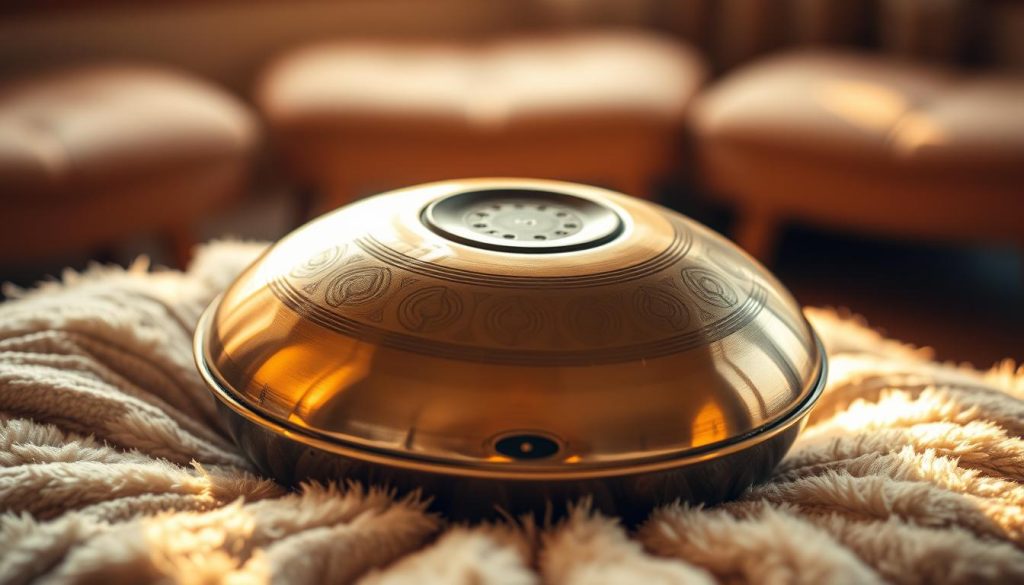
Number of notes and dome layout: standard configurations, extensions and bottom notes
The number of notes and the placement of tone fields on the dome directly affect how you play and how much you spend.
8 to 10 notes remain the versatile standard. These layouts suit beginners and experienced musicians alike. They offer familiar ergonomics and a quick learning curve.
9 to 10 notes are especially suitable if you want room to progress without sacrificing melodic variety. They make improvisation easier while maintaining a stable sound balance.
Extensions: 11 to 15 notes and other variations
Layouts with 11 to 15 notes expand your melodic range. They introduce variations such as a double ding, an off-center ding or small high notes.
However, more notes mean more crosstalk and a harder balance to achieve. Some notes can also be more difficult to reach, sometimes requiring you to turn the instrument on a stand.
Bottom notes (Mutant / Masterpiece)
Bottom notes add lower registers without requiring another instrument. But these “monsters” cost more: allow an extra €100 to €200 per note and often €2,500 to €5,000 for an elaborate layout.
Practical advice: master a standard layout before investing in extensions. It will enrich your playing for years to come.
Choosing a scale: minor, major, Middle Eastern… and why you cannot simply change it
The scale you choose immediately shapes the instrument’s emotional character and technical limits. Important note: a handpan’s scale is set during manufacture; to switch scales, you will need another instrument.

Sound colors
Minor scales often sound introspective and meditative. Major scales tend to sound brighter and more cheerful.
D Kurd remains an intuitive reference point. It makes improvisation easier for beginners and helps you quickly find a sound you enjoy.
Other options — Amara, Pygmy, Akebono and Hijaz — offer distinct worlds of sound, from unusual modal colors to almost vocal tones.
Emotional fit and intended use
Choose your scale to suit its use: meditation or sound healing often favors minor tones. Performance and group playing can benefit from more assertive, clearer scales.
- Listen to plenty of demos to find the scale that resonates with you.
- The number of notes changes how versatile you can be within that scale.
- If your needs change, the used market lets you explore other scales without making a large investment in a new instrument.
Materials and sounds: nitrided steel, stainless steel, sustain and playing feel
The material has a major effect on how a handpan responds beneath your fingers.

Nitrided steel: crisp attack and percussive playing
Nitrided steel undergoes a surface treatment that hardens the sheet metal. The result is a precise attack and short sustain. This treatment suits fast, percussive patterns.
Watch out for moisture: a scratch can expose the underlying steel and cause corrosion.
Stainless steel: versatility and easier care
Stainless steel contains chromium throughout the metal. It resists corrosion better and needs little maintenance.
Its sustain is medium to long, depending on thickness, making it a suitable material for a first purchase.
Touch, thickness and playing response
Sheet thickness and surface finish affect projection, dynamics and tone. The same type of steel can feel very different from one maker to another.
Try several instruments to assess their dynamics, feedback beneath your fingers and consistency.
| Property | Nitrided steel | Stainless steel | Recommended use |
|---|---|---|---|
| Attack | Precise, percussive | Soft, balanced | Fast or versatile playing |
| Sustain | Short | Medium to long | Choose to avoid notes masking one another in your playing style |
| Care | Keep it protected from moisture | Little maintenance needed | Stainless steel recommended for beginners |
To learn more about buying your first instrument and choosing beginner-friendly equipment, consult this beginner’s guide.
Tuning reference: 440 Hz for ensemble playing, with 432 Hz as an alternative
The tuning reference determines compatibility with other musicians and repertoires. 440 Hz has been the international standard since the 1950s. It makes ensemble playing with almost all other instruments easier and suits concerts and recordings.

432 Hz is a lower-pitched alternative. Some players prefer it for what they feel is a more natural or meditative sound. It can change the handpan’s perceived color and warmth.
Musical compatibility and personal choice
The main limitation of 432 Hz is compatibility. If you play with other instruments tuned to 440 Hz, the difference creates dissonance. That limits group playing.
No strong scientific evidence confirms specific therapeutic benefits of 432 Hz. Preferences remain subjective and aesthetic.
| Frequency | Advantage | Disadvantage | Recommended use |
|---|---|---|---|
| 440 Hz | Compatible with most instruments | Some perceive it as less “warm” for meditative solo playing | Ensemble playing, performance, recording |
| 432 Hz | Lower, more meditative sound | Incompatible with instruments tuned to 440 Hz | Solo playing, sound healing, wellness |
- Listen to several comparison recordings to hear the difference in tone.
- If you often play in an ensemble, favor 440 Hz to maintain musical consistency.
- For solo and meditative use, 432 Hz may be a good choice.
- Remember: the scale and sustain often have more influence than the tuning reference alone.
- Many brands now let you order an instrument tuned to your preferred reference pitch; base your decision on the musicians you play with.
Handpan budget and prices: realistic ranges and what affects the cost
Setting a realistic budget helps prevent disappointment when buying a handpan. Market price ranges make it easier to compare offers calmly.
As a guide: expect to pay between €1,000 and €2,500 for a quality instrument with 8 to 10 notes. Very low prices of €300 to €500 often conceal tuning problems and nonexistent after-sales service.
Each additional note generally adds €100 to €200. Complex layouts with bottom notes or “masterpiece” designs often cost between €2,500 and €5,000.
| Item | Price range | What it means |
|---|---|---|
| 8 to 10 notes (quality instrument) | €1,000 to €2,500 | Good versatility, warranty and after-sales service |
| Additional note | Extra €100 to €200 per note | More complex tuning and more crosstalk |
| Masterpiece / bottom notes | €2,500 to €5,000 | Refined sound, high cost |
| Very cheap offers | €300 to €500 | Risk: poor tuning and no after-sales service |
A used instrument can be a real opportunity if the brand is known and the handpan can be retuned. Test its pitch accuracy, sustain and crosstalk, and look for a serial number.
Also budget for a sturdy case and possible retuning. In short, prioritize quality over an impulse purchase.
Scams and questionable websites: warning signs, company details and after-sales service
Before buying an expensive instrument, learn to spot the signs of an unreliable website.
Warning signs: rock-bottom prices of €400 to €500, unverified reviews hosted by the seller, copied photos or logos, and missing or incomplete company information.
Prices, reviews and legal identity
An unusually low price for a handcrafted handpan often signals poor quality or a scam. Be wary of offers that seem too good to be true.
- Check the company details: company name, SIRET registration number, address, person responsible for publication, VAT number, email address, phone number and web host.
- Cross-check reviews on independent platforms such as Trustpilot and on social media.
- Test the after-sales service: write to customer support to assess its responsiveness and expertise.
What to do if you are still unsure
Save copies of the terms of sale, return policy and warranty before paying. Keep your correspondence with the seller.
| Sign | Risk | Recommended action |
|---|---|---|
| Unusually low price | Poor tuning or a counterfeit | Request proof, detailed photos and a serial number |
| Missing company details | Seller cannot be identified | Do not buy; ask for the SIRET number and address |
| Unverified reviews on the seller’s site | Fake customer reviews | Look for independent reviews and testimonials |
Practical advice: favor buying directly from a maker or a recognized retailer with a showroom and a retuning service.
To understand realistic price ranges and avoid pitfalls, also read the guide to handpan prices.
Ayasa, Yishama, Shellopan: how to choose a brand
A maker’s reputation rests on stable tuning and transparent practices.
Market position and reputation
Compare consistency: look for similar quality across several instruments. A good maker provides serial numbers and carries out quality checks.
After-sales service and retuning: clear terms and a straightforward shipping process are essential to a handpan’s longevity.
Sounds and uses
Listen to varied demos from the same maker to identify its distinctive sound and how its instruments sustain.
Match your choice to your style: percussive playing, atmospheric textures, accompaniment or performance. Each maker emphasizes different nuances.
Lead times, availability and budget
Expect sometimes lengthy lead times and higher prices for premium instruments. Scarcity often helps explain the extra cost and stronger resale value.
Factor production time and the cost of any future retuning into your budget.
Suitability for your level
Beginners should favor easy-to-play instruments and responsive service. Advanced players may prefer more responsive, precisely voiced instruments.
Ask musicians who own these handpans whether they suit your skill level and style.
- Compare sound consistency and quality control.
- Check retuning terms and after-sales service.
- Try several instruments before deciding, whenever possible.
Where to buy in France: makers, established retailers and in-person trials
Favor places where you can try several instruments in person before buying. It is the most reliable way to choose a handpan that suits your ear.
If possible, buy in France or elsewhere in Europe to make support and retuning easier. Local makers often offer more responsive after-sales service and reasonable return times.
Before visiting, contact the retailer to book a trial. Ask for audio or video recordings of the exact instrument, rather than a generic model.
- Showroom: compare several handpans in one place to save time.
- Festivals: try many instruments in one day and talk with musicians.
- Checks: company details, terms of sale, cancellation rights and business contact information.
| Buying option | Advantage | What to check |
|---|---|---|
| Buy directly from the maker | Local support and retuning | Production lead times, after-sales service |
| Retailer / showroom | Choice of brands, on-site trials | Model availability, trial arrangements |
| Festival / gathering | Quickly try instruments with different tones | Plan your comparisons and book trial times |
Record your impressions against the same criteria so you can compare objectively. Use this article as a checklist on your visits to make the most of your time and trials.
Common mistakes to avoid when choosing a handpan
Buying too quickly without trying an instrument can turn the dream of a great sound into disappointment. Before buying, take a moment to review your criteria and arrange comparison sessions.
Rushing into the wrong scale or choosing too many notes
Avoid choosing too many notes at first. Layouts with 8 to 10 notes remain versatile and help prevent harmonic muddiness.
Too many notes can make the instrument harder to control and the music less clear, especially for beginners.
Putting appearance ahead of sound quality
Do not sacrifice accurate tuning for an attractive finish. A beautiful instrument can hide unstable tuning.
Listen through headphones and try it in person. If you are a beginner, ask an experienced musician to play it for you.
- Do not choose a scale on impulse: listen to plenty of demos.
- Beware of very cheap offers without after-sales service or retuning.
- Check that the sustain suits your style to avoid a muddy sound.
- Record your impressions against your criteria to reduce bias.
- Give yourself time after the trials to make your decision.
- Avoid websites without complete company details.
Recommended purchases for different players
Some layouts suit particular experience levels and goals better than others.
Beginners: prioritize simplicity so you can learn quickly and keep enjoying the instrument.
Beginner
Recommendation: 9 to 10 notes, D Kurd scale (minor), stainless steel, 440 Hz.
This layout offers straightforward ergonomics, stable tones and easier maintenance. It helps new handpan players get started, including those who play in groups.
Intermediate and professional players
Consider extensions of 11 to 15 notes or bottom notes if your performance and composition needs call for them.
For precise percussive playing, nitrided steel provides attack and definition. For long, flowing textures, stainless or Ember steel favors warm sustain.
- Match the material to your style and budget.
- Try several instruments to find the sound that suits you.
- Allow for the extra cost per note and any ongoing support.
| Player | Notes | Material | Tuning reference |
|---|---|---|---|
| Beginner | 9 to 10 | Stainless steel | 440 Hz |
| Intermediate | 11 to 12 | Nitrided or stainless steel | 440 Hz or as the project requires |
| Professional | 13 to 15, plus bottom notes | Nitrided, Ember or stainless steel | As performance needs require |
Remember: keep sound quality and consistency as your main criteria. Try, compare and choose according to your level to enrich your musical possibilities.
Conclusion
Ultimately, your ear is the best judge of a handpan. Prioritize sound quality: tuning accuracy, harmonics, crosstalk and sustain should guide your decision.
Remember that the scale is set during manufacture. Listening through headphones, then trying instruments in a shop or at a festival, helps you compare tones and ergonomics.
Your plan: listen, try, compare, check, then buy. Confirm the after-sales service and retuning options before paying.
Stick to a realistic budget to avoid unwelcome surprises. Think about how your needs may evolve: you might eventually want extensions or a second instrument.
This guide is a checklist. Take your time, trust your musical instincts and choose the instrument that will inspire you every day.