
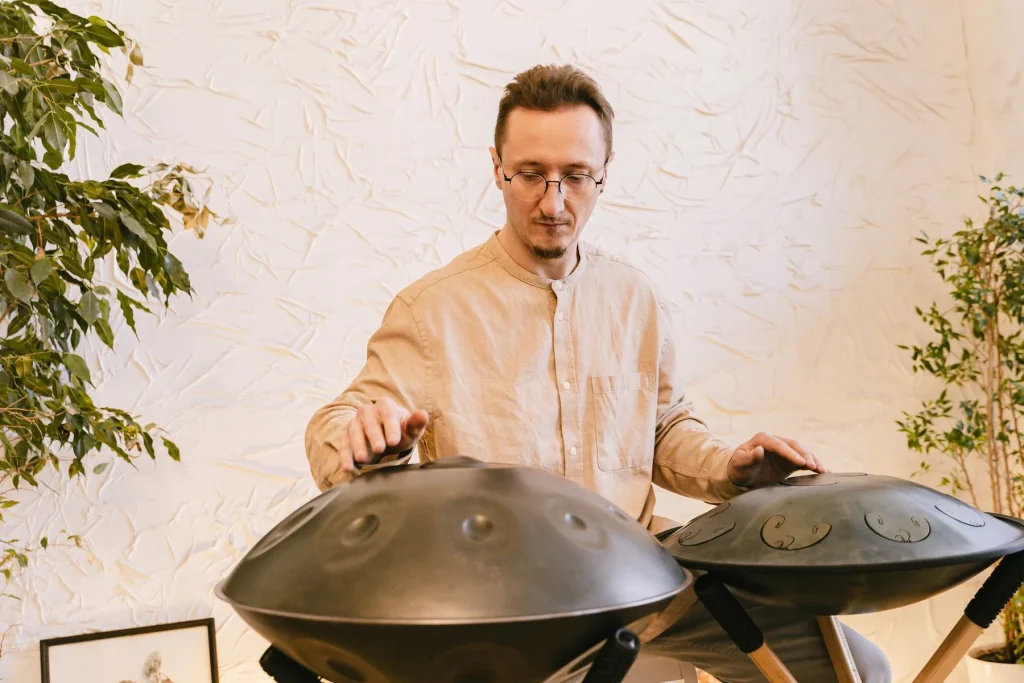
Goal: suggest specific pieces for an accessible, intuitive instrument and show how to learn to play your first melodies while keeping enjoyment at the heart of your practice.
The instrument produces rewarding sounds from the first few strikes. Beginners progress quickly, even without reading music, thanks to free resources offering sheet music and tablature in PDF format.
Two approaches work well together: tablature, which is highly visual when starting out, and sheet music, which gives structure to rhythm and dynamics. Here we will focus on the D minor scale (D Kurd), often used for eight-note models.
You will find step-by-step sequences, advice on tempo and fingering, and practical tips such as laminating practice sheets or using online tools to create your own scores.
To learn more about notation and range, see this useful guide to clefs and reading music: choosing a clef for notation.
Why an 8-note handpan is ideal for beginners
With a limited number of notes, learning feels smoother and more motivating. For beginners, this instrument reduces complexity: fewer playing areas to remember means more attention for sound, technique, and tempo.
It sounds musical right away. Even without reading music, its selected scales produce coherent melodies. This encourages regular practice and makes the first sessions enjoyable.
The compact layout makes it easier to coordinate your hands and read playing diagrams. Visual tablature shows the instrument from above, making each note easier to locate.
- Gentle learning curve: start without prior knowledge, then add sheet music as you progress.
- Practical tunings: tunings such as D Kurd are well suited to beginners.
- Useful resources: print a tablature, follow a step-by-step guide, or take online lessons to learn to play in time.
In short, this percussion instrument lets you adapt pieces to the notes available on your own handpan.
Handpan sheet music vs. tablature: which should you choose to learn to play?
The choice between tablature and sheet music can quickly affect your progress. Tablature shows the instrument from above and clearly indicates where to strike. It is intuitive, often color coded, and ideal for beginners who cannot read music.

Tablature offers immediate readability, a spatial guide to the playing areas, and quick memorization. It lets you play a melody without getting lost in standard musical notation.
Its limitation is clear: it does not always show note lengths or tempo. Tablature also varies with your instrument’s tuning and number of notes, making it difficult to standardize.
Simplified sheet music: structure, precision, and progress
Simplified sheet music uses numbers and symbols to show which pitch to play, how long to hold a note, and where to place an accent. It helps you develop steady timing, dynamics, and hand coordination.
- Recommended combined approach: begin with the more intuitive tablature, then move to sheet music to master tempo and expression.
- For musicians: musical notation provides skills transferable to other instruments and improves your understanding of rhythm.
- Practical tip: always check that a resource matches your tuning; otherwise, adapt the transcription.
For further information and a practical comparison, see this useful page about the instruments and their alternatives: tongue drum or handpan.
Reading simplified handpan sheet music: notes, beats, and rhythm
Understanding simplified notation helps you play rhythmically from the first few bars. A simplified score numbers the bars and divides each one into beats. Subdivisions show exactly when to strike each playing area.
Matching numbers to notes: each number refers to a note on the instrument. The central Ding is marked “D,” making it easy to recognize regardless of the tuning.
Bars, beats, and tempo
Bars provide reference points for organizing rhythm. Subdivisions (eighth and sixteenth notes) place each strike at the right moment.
Tempo is expressed in BPM. For example, 80 BPM provides a slow, steady framework. You can change the tempo with markings such as “accel.” or “rit.”
Dividing notes between the right and left hands
The central line of the staff separates the upper part (right hand) from the lower part (left hand). This lets you see immediately which hand plays each note.
Common symbols and effects
- S = Slap, T = Tak, P = Palm mute.
- M = Muted, – = ghost note.
- Other letters: d (shoulder), F (fist), K (knock). A finger roll is often underlined.
Accurate technique: strike the right place with appropriate force to keep each note clear. Tablature helps you locate the note, while sheet music indicates its duration and tempo: together, they guide your playing.
Practical tip: work on a few bars at a time, count the beats aloud, and use a metronome. For more help reading tablature and sheet music, see this useful resource: reading sheet music and tablature.
Essential playing techniques for clear melodies
For clear melodies, first work on the quality of each strike and control of your hands. A controlled strike preserves resonance and keeps musical phrases distinct.
Types of strikes, fingers, and accuracy
Use your fingertips for a precise tone. Avoid broad gestures: a short, relaxed movement is enough.
- S (slap): a brief accent; use it carefully to avoid damaging the instrument.
- T (tak): a strike on the edge for a crisp attack.
- P (palm mute): dampens the note and helps vary its tone.
- K, F, d: knock, fist, or shoulder effects; use these percussive sounds with care.
- A ghost note (-) marks the rhythm without a ringing tone. A finger roll creates a rapid series of strikes.
Managing dynamics and release for a clean sound
Work gradually from soft to loud. Lift your finger immediately after impact unless the notation says “muted.”
- Isolate a short pattern.
- Repeat it slowly with a metronome.
- Increase the speed while maintaining accuracy.
| Technique | Effect | Tip |
|---|---|---|
| Fingertips | Clear tone | Use a short, economical movement |
| Slap / Tak | Percussive accent | Use sparingly to protect the instrument |
| Palm mute | Damped tone | Use it to vary the dynamics |
| Ghost note / Finger roll | Rhythm and rolls | Add them to a pattern for greater fluidity |
Tip: use sheet music for dynamics and tablature to memorize the note layout. Record yourself to adjust the balance between your hands and the consistency of your sound.
8-note handpan sheet music: ideas for simple pieces
Short, repeated sequences make it easier to memorize patterns and play accurately.
Beginner patterns in D minor (D Kurd)
Start by repeating Ding-3-4 patterns, concentrating on steady beats. These simple phrases help you distinguish each note and strengthen your rhythmic stability.
Arpeggios, ostinatos, and short, gradually developing melodies
- Arpeggio: ascend and descend through 3 to 4 notes, with a slight accent on the first note to guide the tempo.
- Ostinato: the left hand plays a two-beat pattern while the right hand plays a melody using simple note values.
- Add a few S (slap) accents on offbeats, an occasional P, and a finger roll to decorate the phrase.
Building a routine
- Start at 60 to 70 BPM with 4 well-played bars.
- Increase by 5 BPM if everything remains clear; stop at the first mistake.
- Combine sections: A (arpeggio), B (ostinato), C (melody) → ABC, ABAC to develop your memory.
Practical advice: write your variations on handpan sheet music and use tablature to visualize your instrument’s note layout. Record yourself and swap the roles of your hands to improve coordination.

Practical exercises for tempo, rhythm, and coordination
Begin by establishing a steady, simple pulse before adding embellishments. Practice slowly, one section at a time, and use a metronome or videos to keep the tempo.
Record yourself regularly to check your timing and the balance between your hands. Sheet music structures rhythm and duration; tablature helps you visualize note positions.

- Pulse exercise: play the Ding on every beat at 60 BPM, then alternate between the Ding and a neighboring low note for 2 minutes to steady the tempo.
- Subdivisions: play 2, then 3 subdivisions per beat, alternating the right hand and left hand to make transitions smoother.
- Coordination pattern: one hand plays an ostinato on beats 1 and 3 while the other plays offbeats; then reverse their roles to balance your reflexes.
- Accents and dynamics: emphasize the first beat of each bar, then relax; practice each strike with crescendos and decrescendos to control tone.
- Practice sequence: 10 minutes on tempo, 10 minutes on coordination, and 10 minutes applying both to a real musical pattern.
Tip: write down your bars as sheet music and use tablature to memorize the note layout. Make a weekly recording to measure your progress in rhythm and playing the handpan.
Tools and resources to start learning the handpan now
The right tools speed up learning and let you hear your patterns in real time.
Composing and using sheet music and tablature with Notepan
Notepan is practical and offers a free option. It lets you choose the number of notes, scale, and tuning. You can listen to playback, adjust the tempo, and view the structure.
Simple process: choose a tuning → place the notes → adjust the tempo and dynamics → export or print for practice.

Online courses and methods: progress step by step
Choose a structured method: videos, focused exercises, and listening feedback. Programs such as “Master the Handpan” offer a helpful learning path.
“Guided repetition and listening to your playing speed up learning.”
Adapting sheet music to your type of instrument
Always check that your sheet music and tablature suit your instrument. Adapt the layout and range to its type and number of notes so the result sounds right.
| Tool | Use | Benefit |
|---|---|---|
| Notepan | Compose and listen | Set the number of notes and tuning |
| Online courses | Progressive learning | Step-by-step guides and exercises |
| Personal library | Store patterns | Quick review and adjustments |
To expand your resources and find suitable files, explore the note catalogue, which offers options for different tunings.
Conclusion
Keeping the essentials in mind helps you make steady progress.
The two approaches—tablature and sheet music—complement each other. Start with tablature to memorize the note layout, then use sheet music to work on rhythm and expression.
The eight-note handpan remains ideal for developing your skills. Practice slowly with a metronome and record your sessions to track your progress.
Create your own handpan sheet music, adapt each pattern to your instrument, and share your discoveries with other musicians. To find files and examples, explore these handpan scores.
Choose a short pattern today, turn it into a brief piece, and play it often. One note at a time, your music will come to life.