
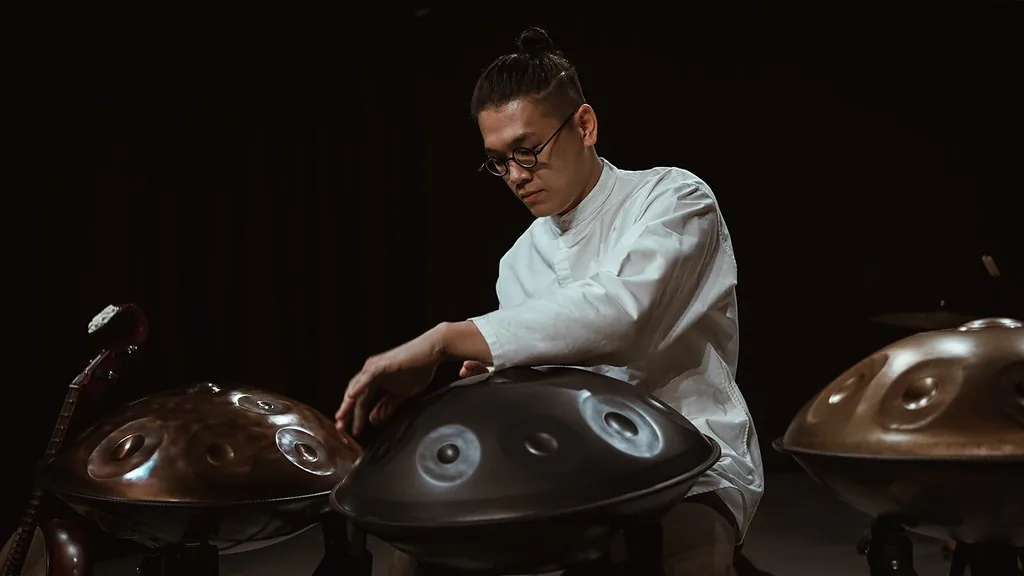
Goal: this guide offers a clear, accessible way to understand sheet music for the handpan. It provides practical advice, free tools, and worksheets to help you progress step by step.
Who it is for: motivated beginners and curious musicians who want to give their learning more structure. The explanations use suitable sheet music and tablature without requiring advanced music-reading skills.
You will learn to read a score, put what you read into practice, and play more independently. The method combines standard notation and handpan-specific tablature so you can choose the approach that suits you.
The guide also covers useful tools: a metronome, recordings, step-by-step lessons, PDFs, and Notepan for composing. Follow a simple progression from essential techniques to short pieces and then a wider repertoire.
Understanding a 9-note handpan and what it means for your sheet music
Understanding the instrument’s layout and numbering helps you memorize patterns faster.
Construction and numbering: the instrument has a central Ding surrounded by tone fields. In simplified notation, the Ding is marked “D,” and the number “1” identifies the lowest surrounding note.
Physical layout: the shell’s shape guides the movement of your hands. The surrounding tone fields follow a logical arrangement that makes reading and moving between notes easier. A central bar separates right-hand strikes, shown above it, from left-hand strikes, shown below it.
The D Kurd scale and its note equivalents
D Kurd is a common scale because its notes work well together melodically. As a guide, D = D3, 1 = A3, 2 = Bb3, 3 = C4, and so on. These equivalents are useful even if you have little experience reading music.
- With fewer tone fields, the range of available sounds stays focused.
- Numbering helps you read more quickly, one measure at a time.
- Listen to each tone to connect its number, position, and sound.
To get started, combine reading the notation with active listening. If you prefer, resources on reading tablature can make learning easier.
Sheet music or tablature for the handpan: how to choose
Depending on your goal, either structured notation or a visual guide may work better.
Sheet music is a widely understood visual language. It shows pitch, duration, and rests. It is especially useful for working on rhythm, dynamics, and precision.
Tablature gives you a diagram of the instrument. It shows where to strike, sometimes using colors, while two lines indicate which hand to use. It is easy for beginners to follow and helps you start playing without reading standard notation.

When to use each approach
Choose sheet music when you need precise timing, clearly marked rests, or detailed dynamics.
Choose tablature when you want to learn a pattern quickly and memorize the positions.
Combine both approaches to progress
Start with the visual method, then gradually add sheet music for more complete rhythmic guidance. Combining spatial cues with rhythmic structure helps you learn faster.
| Format | Advantage | Limitation | Recommended use |
|---|---|---|---|
| Sheet music | Precise rhythm and dynamics | Positions are harder to visualize | Practicing rhythm and dynamics |
| Tablature | Quickly locating striking areas | Little information about tempo | Beginners and memorizing positions |
| Combination | Better overall progress | Takes some adjustment | Alternating visual and rhythmic exercises |
Reading simplified handpan notation: measures, beats, tempo, and hands
This section explains how to read a score’s rhythmic structure so you can play each movement confidently and musically.
Measures, beats, and subdivisions: read from left to right. Measures are numbered and divided into beats. Subdivisions show exactly where each strike falls. Mark each division in pencil to make the rhythm easier to follow.
Tempo in BPM: the number indicates speed, such as 80 BPM. At 60 BPM, each beat lasts one second. When the score marks a change, such as a new tempo or “rall.,” adjust your pace and expression.
Center bar and hand lines: the center bar separates the upper line for the right hand from the lower line for the left. Practicing each hand separately makes coordination easier before you bring them together.
“Count quietly at first and use a slow metronome: this steadies your rhythm and helps build muscle memory.”
| Element | Purpose | Practical tip |
|---|---|---|
| Measure and subdivision | Place each note in time | Mark the divisions in pencil |
| Tempo (BPM) | Playing speed | Start slowly, then speed up |
| Center bar | Divide notes between the right and left hands | Practice the lines separately, then combine them |
Number-to-note equivalents (D Kurd): D = D3, 1 = A3, 2 = Bb3, 3 = C4, 4 = D4, 5 = E4, 6 = F4, 7 = G4, 8 = A4, 9 = C5. Play notes whose numbers appear in the same subdivision at the same time. Let a note ring until the next indication.
Handpan tablature: visual reading, advantages, and limitations
In tablature, successive diagrams act like snapshots that guide your hands across the instrument step by step.
Picture the instrument from above: each panel shows its shape and highlights the areas to strike. A simple color code helps you quickly identify the sounds to play.
Overhead diagrams, color codes, and striking areas
How to read them: find the colored area, note its position, and strike it as the spatial directions indicate. The images follow one another like photos of a movement.
Two lines for the hands: when and where to play
Some tablatures show two lines. They tell you which hand should play and help you organize your movements.
What tablature does not always show: tempo and dynamics
An important limitation is that note duration, tempo, and dynamics are often missing.
Use a metronome and listen carefully alongside this method to keep your rhythm steady.
- Advantage: ideal for beginners, with no need for advanced music-reading skills.
- Limitation: less precise than sheet music for phrasing and dynamics.
- Tip: use tablature to find your way around the instrument, then add sheet music and a metronome.
Useful musical symbols and notation for the handpan
Simple marks on a staff indicate specific movements and tones that turn a sequence of notes into a musical phrase.

Common symbols: D = Ding (center), d = shoulder strike, F = fist (use sparingly), K = knuckle, P = palm mute, S = slap, T = tak on the rim, – = ghost note, M = muted, and finger roll = a rapid roll.
How to play them: strike D in the center for a clear resonance. Use d on the shoulder for a dry sound. Practice the finger roll gently to add an ornament without muddying the musical phrase.
Musical intention and instrument care
Musical intention: each symbol specifies an articulation and tone color. A P on a low beat produces a muted effect that supports the rhythm.
Instrument care: keep F and K strikes gentle on untuned areas to protect the instrument. Work slowly with a metronome, practice each effect separately, then combine them.
“Vary your touch and the hand you use to suit the effect: rhythmic precision and efficient movement make all the difference.”
Consult available scores and tablatures to see these symbols in context and judge how much of each technique to use.
From reading to playing: a daily practice method
Turning marks on a score into sound takes short, regular practice. A structured routine turns exercises into musical phrases and builds confidence.
An effective routine: start very slowly with a metronome, settle into a steady beat, then increase the speed gradually in small steps.
Essential tools: a reliable metronome, a smartphone for recording yourself, and instructional lessons help you correct your posture and movements.

Structure each session: warm up briefly, read a passage, practice each hand separately, bring both hands together, and reinforce what you have learned through focused repetition.
Add coordination exercises: play a steady ostinato with one hand and varied patterns with the other to develop their independence.
- Alternate between sheet music and tablature according to your goal: rhythmic precision or a visual guide to the handpan’s notes.
- Set modest goals: master two measures, join them together, then add the next one.
- Record yourself often: listen for timing and dynamics, then improve your transitions.
“Practicing slowly keeps mistakes from becoming habits and helps you speed up more cleanly.”
Motivation: vary your exercises, create short melodies from patterns you have learned, and recognize each milestone to maintain your momentum.
Resources for handpan sheet music and learning
Here is how to find useful PDFs, create your own files, and follow a suitable learning progression.

Download free PDFs and tablature
Tip: look for printable files that state the tuning and number of tone fields. This helps prevent mistakes about note positions.
Choose diagrams with two hand lines and clear visual markers. You can start for free with handpan scores available online.
Composing with Notepan
Notepan lets you choose the scale and number of tone fields, listen as you work, and adjust tempo, duration, and intensity.
Sketch your ideas in tablature first, then write them out as a score to fix the rhythm and dynamics.
Lessons, books, and practice methods
Follow video lessons to check your reading and timing. Collections arranged by level make it easier to practice melodies.
- Print and laminate your worksheets so you can annotate them with an erasable marker.
- Use audio demonstrations to check tone and intonation as well.
- Share your work and ask for feedback on specialist forums.
“Always choose resources that match your instrument and its tuning.”
To find collections of scores and accessories, consult dedicated resources.
Conclusion
The essentials: a clear method combines spatial awareness and rhythm to help you progress quickly.
Understanding the numbered layout, reading measures and beats, identifying the hand lines, and learning the symbols help you play expressively. Combine tablature and sheet music in a way that suits how you learn.
Basic music theory helps, but the method remains intuitive. Regular practice with a metronome, recordings, and online lessons builds your independence.
Compose your own melodies and write them down to expand your collection. Pay attention to hand placement and touch, and favor short, frequent sessions.
Above all, enjoy playing: let your handpan inspire you, and share your creations to keep progressing.