
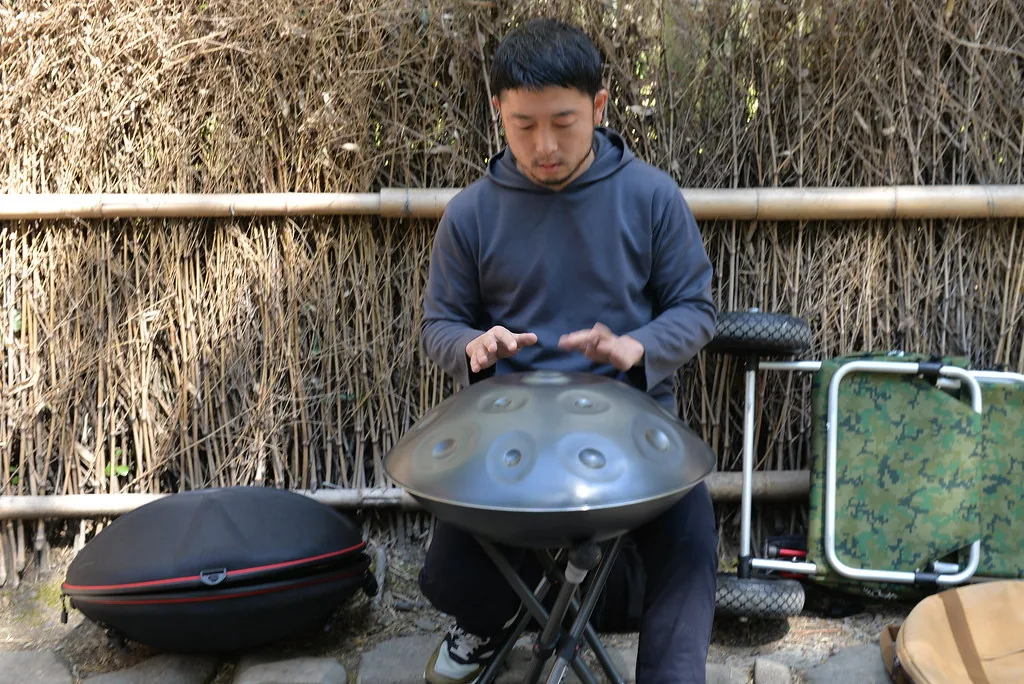
Goal: this article helps explain the main differences between two steel instruments that are very popular in France today.
The first has a hammered surface with a raised center, while the second uses cut-out tongues that vibrate. These construction choices directly affect their sound.
In practice, the handpan offers captivating clarity with moderate to long sustain. The tongue drum produces a gentle, meditative sound with long sustain. Typical diameters range from about 50 to 60 cm for a handpan and 15 to 40 cm for a tongue drum; weights range from 3 to 8 kg versus 1 to 5 kg.
Prices show a similar gap: expect to pay around €800 to €2,500 (or more) for a handpan and around €100 to €600 for a tongue drum. This article covers how they work, their scales, playing techniques, accessories, and care to help you choose according to your practice, budget, and musical expectations.
At a glance: two steel percussion instruments with distinct identities
These two steel percussion instruments look alike but sound different.
Who are they for in France today?
- Performing musicians and enthusiasts willing to invest in an expressive range of sounds.
- Beginners, relaxation enthusiasts, and sound therapists looking for an affordable option.
- Educational workshops, meditation circles, and intimate concerts.
What they have in common…
Both belong to the family of steel percussion instruments. They are played mainly with the fingers or hands. Their soothing character makes them popular in wellness music.
…and what really sets them apart
Their shape and construction determine how they respond to touch: a hammered surface produces rich harmonics, while cut-out tongues produce a more enveloping sustain.
Price and size also vary considerably. These differences affect the choice according to where and how musicians plan to use the instrument.
How they work: a hammered surface and cut-out tongues
The instrument’s shape and vibrating areas determine its acoustic character.
Hemispherical surface, dimples, and ding
On the domed side, recessed areas are tuned through precise hammering to form dimples. Each area produces a specific note.
The central ding often serves as a melodic anchor. The continuous surface encourages interaction between harmonics and creates a stable sound field.

Cut-out tongues and how they vibrate
The cuts create tongues whose dimensions determine their frequency. Each tongue vibrates independently, producing rounded sounds with prolonged sustain.
Effects on touch response and projection
The continuous surface transmits rich harmonics; the cuts divide the vibration for a gentler response. The effect is immediately apparent when playing: light strikes produce crisp articulation on one instrument and more enveloping resonance on the other.
In practice: the surface and shape guide your playing: the first has more pronounced projection nearby, while the second has more diffuse resonance. To learn more about tuning characteristics, see this 432 Hz guide.
Construction, tuning, and long-term care
Construction strongly influences the tuning stability and lifespan of these steel percussion instruments.
For the handpan, construction is a slow, artisanal process. A suitable steel is selected, a dome is formed, and the dimples are precisely hammered. Manual tuning involves successive adjustments to produce a defined scale.
This process can take several months. The instrument remains sensitive to impacts and deformation; professional retuning every four to five years is sometimes necessary.
For the tongue drum, cutting the tongues with a disc or laser establishes the notes’ pitches during production.
The process is faster but requires great precision. Tuning is generally more stable, and the calibrated slits reduce the need for retuning.
- Materials: untreated, stainless, or nitrided steel; nitriding increases hardness but may increase sensitivity to corrosion.
- Care: wipe the instrument after use, store it somewhere dry, apply corrosion-preventive oil, and use a hard case for transport.
- Repairability: a bent tongue can sometimes be straightened; a deformed surface requires a specialist craftsperson.
To choose wisely, keep these differences in construction and care in mind so you can preserve your instrument’s original characteristics.
Handpan vs. tongue drum: sounds and uses
To the ear, one appeals through harmonic precision, while the other charms with its lingering softness.
Sound signature and atmosphere
Clarity and magic: the first instrument offers clear, harmonically rich notes with moderate sustain. It creates airy, precise, and articulate soundscapes.
Long sustain: the second favors enveloping layers of sound. Its tone remains soft and meditative, ideal for creating a calming atmosphere.
Volume, resonance, and perception
Perceived volume can be misleading: long sustain does not necessarily mean strong projection. Diffuse resonance can create an impression of greater volume without improving clarity.
Playing and settings
Both instruments suit meditation, yoga classes, educational workshops, and intimate concerts.
- Play with the fingers and hands to achieve many nuances on the first.
- Use fluid movements or soft mallets to control the second instrument’s sustain.
- In the studio: condenser microphones reveal the harmonics; close miking captures the resonance.
“Choose according to the sound you want: precision for the stage, textures for relaxation.”
For a practical comparison of these instruments, see this dedicated page: comparison guide.
| Criterion | Clarity | Sustain | Recommended use |
|---|---|---|---|
| Signature | Clear harmonics | Moderate | Acoustic concerts, melody |
| Texture | Articulate | Long | Meditation, relaxation |
| Accessibility | Melodic exploration | Easy to control | Workshops, beginners seeking confidence |
Melodic range, notes, and scales
The available notes directly shape the possible repertoire and playing approach for each percussion instrument.
Number and layout of notes
On the first instrument, there are commonly 7 to 10 notes on the upper side. Extensions can add playing areas to the lower shell, sometimes bringing the total to around 21.
For the tongue drum, models generally have 6 to 9 tongues. Some have 6 to 14, offering more sonic possibilities.

Fundamental note and layout
The central ding often structures playing on the hammered instrument; it provides a foundation and melodic anchor.
On the tongue drum, the lowest tongue plays this role, becoming the reference point for patterns and ostinatos.
Available scales and their musical impact
Both types come in major, minor, pentatonic, and less familiar scales. The choice of scale immediately colors the atmosphere.
A greater number of notes provides varied intervals and opportunities for modal improvisation. A smaller number of notes encourages simple, meditative patterns.
- Diameter and construction limit the number of playable areas without sacrificing clarity.
- The trade-off is between melodic variety and intuitive simplicity.
- Modal improvisation works well on the first instrument; soothing ostinatos work particularly well on the tongue drum.
For more on specific scales and the tongue drum’s technical characteristics, see this practical guide: complete tongue drum guide.
Size, weight, and everyday portability
Depending on how often you travel, size and weight may be decisive.
Diameter and transport guidelines
Standard diameter: a handpan is generally 50 to 60 cm across. This size calls for a sturdy case and particular care while traveling.
In practice, its hemispherical shell takes up more space than a flatter model. Consider the room available in a car trunk or on public transport.

Different sizes and mobility
Tongue drums come in small sizes (about 15 to 20 cm) that are very easy to carry and medium sizes (about 30 to 40 cm) that balance projection and portability.
Weight: a handpan often weighs 4 to 5 kg (sometimes 3 to 8 kg). Tongue drums tend to weigh 1 to 3 kg, depending on size and material.
- Practical tip: for workshops or frequent travel, choose a size that suits your means of transport.
- Essential accessories: shoulder straps, hard cases, and protective foam to safeguard the instrument.
- Shape affects how often you use an instrument: a heavier one gets taken out less often, while a more compact model makes daily use easier.
“The choice between onstage expressiveness and urban mobility often comes down to a few centimeters and a few kilograms.”
In short: the key difference is how much space each takes up. The handpan favors stage use and expressiveness; the tongue drum offers mobility without sacrificing the sound experience.
Budget and perceived value: price ranges and realistic expectations
Price differences reflect the complexity of construction and the scarcity of skilled makers.
Why one instrument costs more: artisanal construction takes time, precise manual tuning, and careful material selection. These steps raise the price and limit production volume.
When the more affordable option makes sense: some instruments made by cutting tongues offer an excellent sound experience at a lower cost. They are well suited to beginners, meditation, and workshops.

- Realistic price ranges: about €800 to €2,500 for the first type (sometimes €1,500 to €5,000 for high-end handmade instruments); €100 to €600 for the second.
- Price reflects the finish, materials, and quality control.
- Budget for additional costs: a hard case, stand, corrosion-preventive oil, and regular care.
Buying tip: compare models in a specialist shop and try the instrument before buying to assess its touch response and tuning stability.
“On a tight budget, choose practicality; for a wider expressive range, be prepared to invest.”
| Criterion | More expensive instrument | Affordable option |
|---|---|---|
| Typical price | €800 to €2,500 (up to €5,000) | €100 to €600 |
| Reason for the cost | Craftsmanship, manual tuning, low production volume | Industrial cutting, faster production |
| Recommended use | Stage, studio, demanding musicians | Discovery, meditation, workshops |
Playing, techniques, and essential accessories
The right movements and accessories change the playing experience.
Hands, fingers, and joints: a delicate touch
Technique: favor light strikes with your fingertips to preserve clarity. Practice moving your wrists and finger joints to control the attack without overwhelming the note.
Warm up your fingers with short exercises: bends, stretches, and rolling movements. This improves endurance and reduces the risk of fatigue.
Mallets: dynamic control and accessibility
Precaution: avoid using mallets on the instrument with a continuous surface unless you can precisely control your striking force. There is a real risk of changing its tuning.
Tongue drums, however, work very well with small, soft mallets. They help control volume and create even textures.
Stands, cases, oils, and corrosion protection
An adjustable stand makes it easier to play while sitting or standing. A hard case protects the instrument during transport. Corrosion-preventive oil helps prevent rust after outdoor use.
Flatter models rest easily on the lap, a table, or a stand fitted with rubber pads. This stabilizes the instrument and improves sound transmission.
“Controlled movements and suitable accessories extend an instrument’s life and open up new musical possibilities.”
| Aspect | Practical advice | Benefit |
|---|---|---|
| Finger playing | Light strikes, wrist control | Preserved clarity and harmonics |
| Mallets | Avoid on the continuous surface; use small, soft mallets for the tongues | Control over dynamics and textures |
| Accessories | Stand, hard case, corrosion-preventive oil | Comfort, protection, longevity |
Durability, climate, and conditions of use
Climate conditions strongly affect the lifespan of these steel percussion instruments.
Heat and sun: avoid prolonged exposure to sunlight and extreme temperatures. Heat can soften a handpan’s steel and affect its tuning. If exposed, let the instrument cool completely before playing again.
Moisture and salt: near the French coast, humidity and sea spray accelerate corrosion. Although nitrided steel models are hard, they may be more prone to rust; lower-quality versions may be even less resistant.
Preventive care and good practices in France
Wipe the instrument after each use. Apply a light protective oil to slow oxidation.
Store it somewhere dry, with desiccant packets in the case. Air out the case after transport to prevent mold and rust spots.
- Check the surface and the stand’s pads regularly.
- Choose storage with a stable temperature, away from a car trunk in summer.
- Leave any retuning to a professional; avoid improvised repairs that could damage the instrument.
“Good care habits can make all the difference in preserving these instruments’ tuning and beautiful sound.”
Conclusion
Conclusion
Ultimately, the decision often comes down to onstage expressiveness versus simplicity in everyday use.
In brief, construction (hammering and dimples or cut-out tongues) defines the main differences in sound. The first produces precise, harmonically rich sounds and has stage presence; the second offers gentle sustain, great simplicity, and an accessible price.
Keep the budget guidelines in mind (about €800 to €2,500 for a handpan; €100 to €600 for a tongue drum), along with portability (50 to 60 cm versus 15 to 40 cm) and care (avoid heat and moisture; oil and store somewhere dry).
To choose, try both in a shop or with a community of musicians. Starting with a tongue drum can build confidence; moving on to a handpan may feel natural as your practice develops.
This article aims to put the strengths of these two musical instruments in perspective to help you decide. Both can provide lasting inspiration for musicians.