
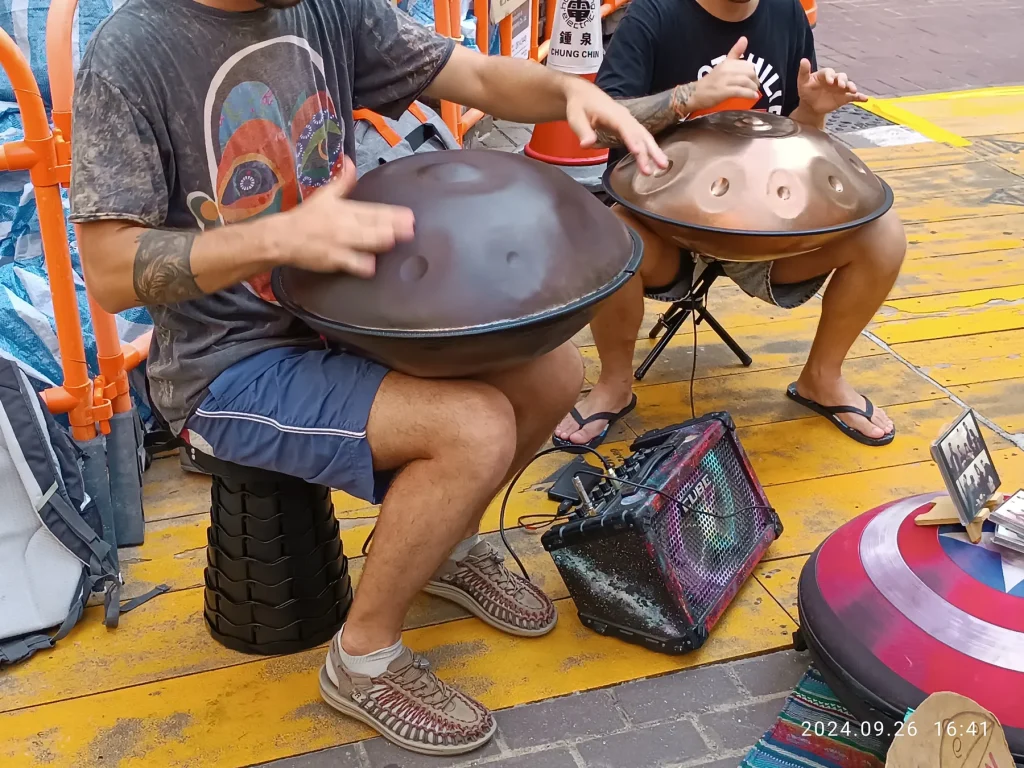
Goal: help you find the right place to buy an instrument, compare shops, makers and online options, make an informed choice and avoid unpleasant surprises.
The market has become more established in recent years. You no longer have to wait months for a single maker. New brands and sales channels make instruments easier to find, but quality varies greatly with construction and tuning.
For a good 9-note instrument, budget around €1,200 to €2,500. This range reflects the time spent tuning, research and makers’ experience.
We will cover the essential criteria: tuning, note stability, tone, ergonomics and whether the scale suits your intended use (meditation, performance or learning).
Before buying, try the instrument if possible, and check after-sales service, the maker’s reputation and the transparency of delivery times. For specific models and prices, consider, for example, Djoliba’s selection of handpans.
The handpan market in France today: availability, quality and budget
The industry has diversified rapidly, with more visible businesses and a wider range of sales channels.
A wider selection, but uneven quality across brands
The growing number of makers and retailers makes instruments easier to find. However, quality can be very different from one model to another.
These differences come from the construction process, the steel sheet, the time spent tuning and the maker’s experience. They directly affect durability and tone.
Current price ranges and what to expect
As a guide, a well-tuned 9-note handpan generally costs between €1,200 and €2,500. This range often buys a stable instrument backed by reliable after-sales service.
Very low prices often conceal compromises in steel quality and tuning accuracy. You may then face additional tuning or repair costs.
- Compare several sellers and request recent audio or video samples.
- Match your budget to your intended use: a good instrument often saves you from having to resell it soon.
- Favor makers who explain their process, lead times and price ranges.
Demand has been increasing for several years, so allow for a wait, especially for custom orders. To assess value for money, see this analysis too: value for money.
Where to buy a handpan in France: shops and makers
There are several ways to buy an instrument with confidence today. Your choice depends on your skill level, budget and need for guidance.
Makers and craftspeople — buy directly by appointment or to order. Benefits include technical discussions, possible customization and after-sales support.
Specialist shops — places to try instruments include Djoliba (Toulouse), La Baguetterie and Percussions du Monde (Paris). They let you compare models and test how they feel to play.

- Makers’ websites or specialist websites: technical information, videos and clearly explained after-sales service. Buying is safer when the site has a good reputation.
- General retail sites: check their reliability; they do not always offer expertise or the best price.
| Channel | Main benefit | When to choose it |
|---|---|---|
| Maker or craftsperson | Customization and ongoing support | When you need a custom instrument or long-term after-sales service |
| Specialist shop | Trying and comparing instruments in person | Trying before buying, beginners or stage use |
| Specialist website | Technical information and warranties | Informed research and a secure purchase |
Tip: combine online research with an in-person visit to refine your decision. For expert guidance, contact the maker directly.
Buying directly from a French maker
Contacting the maker makes technical discussions easier and opens up genuine opportunities for customization.
Benefits of buying directly
Direct contact: discuss construction, your choice of scale and the tone you want.
Customization: tuning adjustments, note choices and finishes may be available for a bespoke instrument.
Essential questions to ask
- How many years have you been making these instruments?
- Can I try one at your workshop, or can you provide recent recordings?
- What guarantees do you provide for shipping, maintenance and after-sales service?
- Do you offer several models and scales?
- Are your stated lead times realistic, and do you have instruments in stock?
- How do you explain your tuning method and professional approach?
- Can you add notes or offer custom options?
Example: Ederod / Endro®
A workshop in Besançon making instruments by hand since 2012. It offers a warm sound, patented steel sheet, retuning and repairs.
| Model | Notes | Price | Scales | Services |
|---|---|---|---|---|
| Endro® 9 | 9 | €1,500 | Integral / Kurd | Shipping, after-sales service, retuning |
| Endro® 10 | 10 | €1,650 | Celtic / Mystic | Custom options, added notes |
| Options | Additional bottom notes | By quotation | Custom | Insured parcel (France: €48; EU: €50 to €70) |
Tip: arrange a workshop visit to try the instrument, compare models and check playing comfort before committing.
Music shops and showrooms in France
Showrooms offer a rare chance to try several instruments side by side.
Useful addresses: Djoliba Percussions (Toulouse), La Baguetterie (Paris) and Percussions du Monde (Paris). Other regional music shops sometimes have models available to try.

Benefits of trying an instrument in a shop
A specialist shop lets you compare tuning quality, tone and playing response.
Try instruments in a quiet setting and take time to listen to each one.
Checking after-sales service and provenance
Important: always ask about the relationship between the shop and the maker. Only the maker can provide reliable retuning.
Call before you travel: stock varies and instruments may be rotated between locations.
- Ask where the brands on offer come from.
- Be wary of “cheap beginner” offers: quality may be lacking.
- Choose a shop that explains its after-sales and shipping procedures.
To learn more about retailers and their services, read the who we are page.
Buying online from a specialist website
A good specialist website should give you confidence about an instrument’s origin, tuning and after-sales service.
Signs of trustworthiness: check that the legal details are complete (postal address and SIRET business registration number), the returns policy is clear and the terms of sale are detailed.
Simple, effective checks
Before placing an order, check verified reviews, recent audio or video samples and clear information about how the instrument is made.
Test the responsiveness of after-sales support: ask a technical question and note how quickly and thoroughly they answer.

Choose established makers and shops
Practical tip: choose the website of a respected maker or an established physical shop. Help is often more reliable if a problem arises.
“A serious commitment to after-sales support is often the best indicator of an instrument’s true quality.”
- Ask for recent videos of the models and details of how they are made.
- Avoid sites without verifiable contact details or with implausible delivery promises.
- Consider a video call or visit to assess the tone before buying.
| Criterion | What to check | Why |
|---|---|---|
| Legal information | Address and SIRET number | Supports transparency and traceability |
| Customer reviews | Recent verified reviews | Helps assess satisfaction and reliability |
| After-sales service | Clearly stated timescales and policy | Allows for retuning and repair if needed |
General retail sites and marketplaces: risks and exceptions
General marketplaces attract many kinds of sellers, but quality is not guaranteed.

On these sites, expertise is often limited. It can be difficult to obtain details about construction, the origin of the steel or proof of tuning.
Finding a good handpan with 8 or 9 notes for under €1,200 is very difficult without compromises. Be cautious: rock-bottom prices often mean low-grade steel or inadequate tuning.
Reported risks include unreachable sellers, no after-sales service and instruments that are out of tune or beyond repair. In some cases, repairs cost more than the original purchase.
An exception may be a respected maker with a clear returns policy. Ask for recent videos, the workshop address and warranty terms before any purchase.
In short, favor specialist websites or shops to reduce risks and check provenance. This improves your chances of getting a good deal.
Second-hand handpans: where to look and how to buy safely
More enthusiasts are reselling instruments within dedicated communities. The second-hand market has grown as players change scales more often.
Reliable groups and communities
French Handpan Connection and other specialist Facebook groups remain among the best places to spot a good used instrument. Members often share its full history.
Essential checks before paying
Buying a handpan from a private seller generally comes without a warranty. Check every point carefully.
- Stable tuning and accurate notes.
- No dents, cracks or corrosion.
- Consistent tone and harmonics.
- Detailed videos showing slow and fast playing, plus each note individually.
- Traceability: original invoice, brand, model, year and scale.
Be wary of listings priced well below the market rate (for example, substantially less than €1,200 for 8 or 9 notes). This often signals hidden problems.
“Always ask to try the instrument in person or seek a maker’s or musician’s opinion before paying.”
| Where to look | Benefit | Risks |
|---|---|---|
| Specialist Facebook groups | Knowledgeable community, traceability | Private transactions without a warranty |
| General marketplaces | Large number of listings | Unreliable sellers, vague descriptions |
| Contact with a maker or musician | Expert opinion, possible inspection | Cost or delay of an assessment |
Meet the seller in a safe place, use a secure payment method and, if possible, have the instrument checked before buying so you do not end up with one that cannot be repaired.
Fairs and festivals: try before you buy
Public gatherings bring makers and players together and offer a unique range of sounds. They let you hear and handle many musical instruments in a short time.
Events to consider
Key events include the Handpan Festival (France), HangOut UK and Griasdi (Austria). These gatherings bring together makers, varied handpans and leading musicians.
Why attend
Benefits: try instruments with different tones, compare finishes and watch playing demonstrations. Short workshops help you assess comfort and response before committing.
Practical advice
Prepare a list of scales to try and criteria to assess: tone, balance and projection. Listen to instruments solo, in a duo and as accompaniment to see how they fit your musical plans.
Write down your impressions and record samples if permitted. Talk to the makers there: they often explain their construction choices and available support.
To continue your search and find a handpan, follow up with contacts you make at events.
Prices, models and notes: setting a realistic budget
The real cost of an instrument often exceeds its listed price. Allow for accessories, insured shipping and possible retuning.
Price guides by quality and number of notes
For a quality 9-note model, budget around €1,200 to €2,500. The price varies with construction, finish and tuning time.
The more notes an instrument has, the more complex tuning becomes. A 10-note model takes more tuning time and therefore often costs more.
New or used: balancing cost, waiting time and security
A new instrument generally includes a warranty and after-sales service, making the purchase safer. A used one costs less but may offer no recourse if its tone or stability proves problematic.
Example: Ederod offers a 9-note model for €1,500 and a 10-note model for €1,650. These prices reflect careful craftsmanship and after-sales support.
| Factor | Effect on price | Advice |
|---|---|---|
| Number of notes | More complex tuning and higher cost | Choose according to use (meditation, stage or learning) |
| Materials and steel | Quality and treatment of the steel sheet | Favor makers who are open about construction |
| Services (after-sales support, retuning) | Added value after purchase | Allow a budget for maintenance |
Tip: prioritize stability and quality over immediate savings. A good instrument can spare you extra costs and an early resale.
Quality criteria and choosing a scale
Choosing the right scale starts with understanding how materials and tuning affect the sound.
Materials and construction: a good instrument uses nitrided steel or properly treated stainless steel. These metals reduce oxidation, improve projection and help the instrument stay in tune.
Research, steel and tuning stability
Construction and research and development matter. Steel sheet designed for music, including some patented solutions, requires hours of testing. This contributes to long-term note stability.
Tuning, harmonics and tone
Listen for accurate tuning, balanced harmonics and consistent tone. Tuning is very difficult: mastering it takes thousands of hours of practice.
Choosing a key for your intended use
As a guide to scales: Integral/Kurd is versatile, Celtic/Amara is rounded and warm, and Mystic is deep and contemplative. Depending on your playing, stage work calls for projection, meditation favors resonance and softness, and learning benefits from a forgiving, inspiring scale.
“Trying several scales and requesting recordings helps you choose according to your tastes.”
Tip: ask about custom options to adapt the instrument’s response and range to your plans.
French makers and brands to discover
Several French makers now offer very different tones, each with a distinctive sound.
Established makers
Metal Sounds / Spacedrum, Ederod / Endro® (Besançon, since 2012, fifth generation) and Shellopan (near Strasbourg) are known for their local roots and serious follow-up service.
Small workshops to explore
Smaller workshops include Baopan, Elixia (Rennes), Mayura, Ostara (Chauffailles), Naos (Grenoble), Esapan (since 2013), Avalon (Normandy) and Mypan. They offer handcrafted handpans with varied sound characteristics.
Many offer D minor models (Kurd/Integral, Celtic/Amara, Mystic), and some make custom instruments. Lead times and prices vary with demand and the degree of customization.
- Tip: visit a workshop or shop when possible to feel how the metal responds.
- Follow brands at festivals and on their websites to hear recordings and check availability.
- A French maker often makes after-sales service (retuning and repairs) and shipping arrangements easier.
Contact several workshops to compare offers, scales and availability. To continue your research, you can also find a handpan through the contacts you have made.
Conclusion
Combine research, listening and hands-on testing before making a decision.
Practical tip: identify two or three reliable contacts (a workshop, specialist shop or reputable website), listen to demonstrations, check after-sales service and set a realistic budget.
Prioritize quality, tuning stability and playing comfort over offers that seem too good to be true. Today, the local network can provide lasting support and genuine guidance.
To compare listed retailers quickly, consult this retailer network and arrange a visit to try an instrument. Thank you for reading: try some instruments and bring your musical plans to life.