
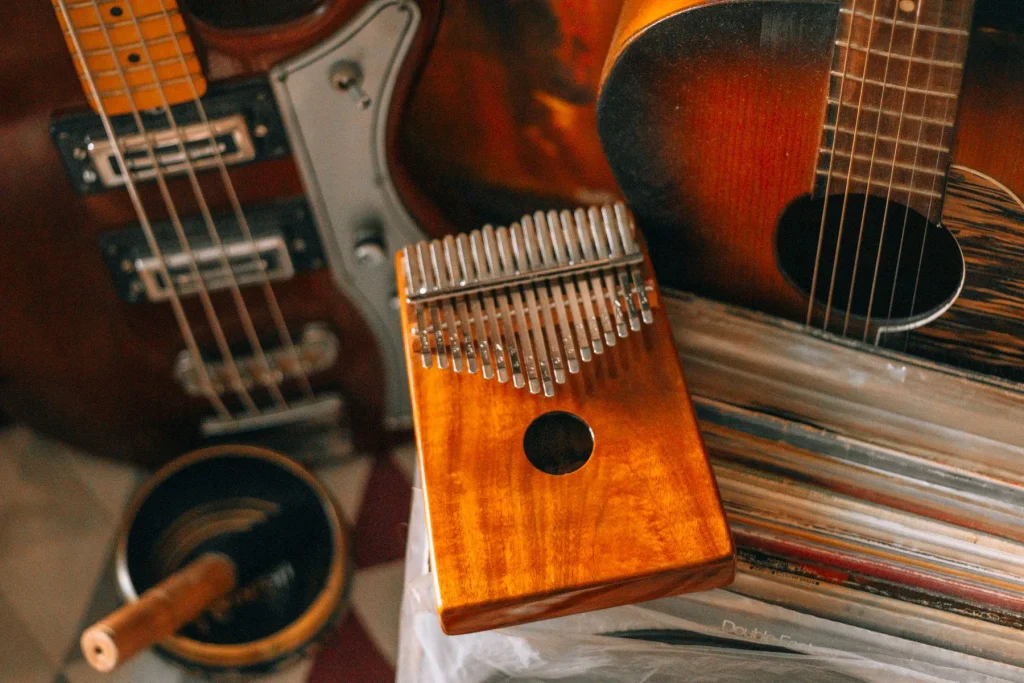
The kalimba is a fascinating musical instrument that draws attention with its resemblance to a small thumb piano. Its steel tines produce gentle, captivating sounds. Invented by Hugh Tracey in the 1950s, it was inspired by the mbira, a traditional African instrument dating back 3,000 years.
The central question of this article is: what is a kalimba and how does it work? This exploration is for musicians and curious readers alike. As an enthusiast with more than 10 years of playing experience, I will share information about the instrument’s origins, construction, and distinctive sounds.
The kalimba is accessible to beginners while offering experienced musicians a rich range of sounds. Its growing popularity in Western homes can be explained by its compact size and ease of learning. The instrument belongs to a centuries-old tradition recognized by UNESCO in 2020, underscoring its cultural importance.
What is a kalimba? Definition and overview
The kalimba, often called a thumb piano, is a fascinating percussion instrument. Invented by Hugh Tracey in the 1950s, it was inspired by the mbira, an older African instrument. A kalimba consists of steel tines mounted on a wooden or acrylic body. The tines vary in length and produce sounds when the player plucks them with their thumbs.
In its original form, Hugh Tracey’s standardized kalimba had 15 keys. Each key corresponded to a note in Western music, such as C, D, E, F, G, A, or B. Today, most kalimbas on the market have 17 keys, although models with 5, 7, or even several dozen tines also exist.
A kalimba player, known as a kalimbist, uses their fingers to create gentle melodies. This playing style makes the instrument an ideal musical companion for travelers and musicians seeking simplicity. The kalimba’s distinctive sound often evokes childhood memories and appeals to an increasingly wide audience around the world.
Here is a summary of the kalimba’s main characteristics:
| Characteristic | Details |
|---|---|
| Instrument type | Percussion instrument |
| Number of keys | 15 to 17 keys (standard), up to several dozen on chromatic models |
| Playing method | Played with the thumbs |
| Sound | Gentle and melodic, evoking childhood |
| Weight | Compact and lightweight |
| Related terms | Kalimbist (player), thumb piano, sansula, sanza, mbira |
In short, the kalimba combines simplicity with a beautiful sound. It is accessible to beginners while offering experienced musicians plenty of expressive possibilities. To learn more about the instrument, you can read this article.
Historical origins: from the African mbira to the birth of the kalimba
The kalimba’s roots lie in the history of the mbira, an ancient musical instrument. Originating in sub-Saharan Africa, this instrument appeared about 3,000 years ago on the continent’s west coast. The mbira is a percussion instrument often described as a thumb piano. It consists of a rectangular wooden board measuring about 20 × 15 × 2 centimeters, with steel tines attached to it.
The number of tines generally ranges from a few to around thirty. Metal caps are sometimes added to enrich the sound. The mbira has a central role in Shona culture. It is used at weddings and official ceremonies, as well as to communicate with spirits. This musical tradition is both a means of expression and a spiritual connection.
In the 1950s, British ethnomusicologist Hugh Tracey encountered the mbira in Southern Rhodesia, now Zimbabwe. Impressed by the instrument, he developed a Westernized version that he called the kalimba. Hugh Tracey standardized its notes according to Western music theory and arranged the keys in a single row. He also added a hollow wooden resonator box and made playing easier with note-identification stickers.
These changes helped the kalimba reach a wider audience. In 2020, the art of crafting and playing the mbira was inscribed on UNESCO’s list of intangible cultural heritage, highlighting its historical and cultural importance.
To better understand the instrument’s development, here is a comparison of the traditional mbira and the modern kalimba:
| Characteristic | Traditional mbira | Modern kalimba |
|---|---|---|
| Origin | Sub-Saharan Africa | Created by Hugh Tracey |
| Number of keys | Varies, from a few keys to around thirty | Generally 15 to 17 keys |
| Key arrangement | In several rows | In a single row |
| Cultural use | Ceremonies and rituals | Contemporary music and recreation |
| Recognition | Cultural heritage | Recognized by UNESCO in 2020 |
In short, the kalimba grew out of the mbira and has crossed ages and continents, changing while retaining its essence. To explore the instrument further, take a look at this article.
Construction and characteristics of the kalimba
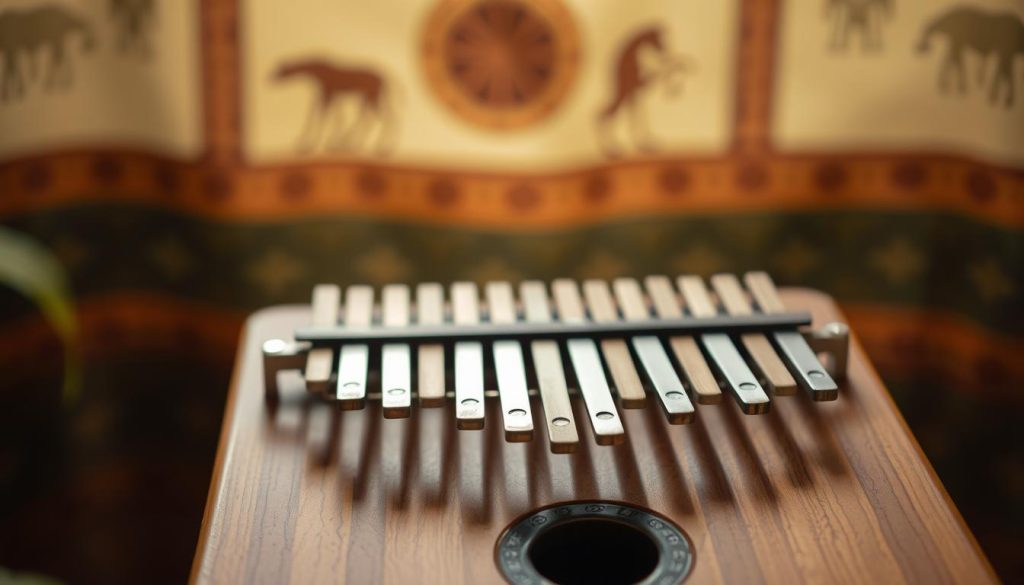
The kalimba has distinctive characteristics. It consists of several essential parts that shape its sound and appearance.
The soundboard: support and resonator
The soundboard, which also serves as the body, is traditionally made of wood. Some models are made of acrylic glass. On kalimbas with a resonator, the body is hollow and has a hole on the front: it acts as a resonator box and amplifies the sound.
There are two main types of kalimba: hollow models and flat models. The former have a resonator box and offer a richer sound, while the latter consist of a simple wooden board.
The front and rear bridges and the pressure bar
The bridges, firmly attached to the soundboard, support the steel tines. The front bridge often has a horizontal metal bar. This bar improves the transmission of sound waves and enriches the instrument’s acoustic quality.
The pressure bar sits between the two bridges. It holds the tines against the soundboard and provides the tension needed to produce sound when the musician plays the keys.
The steel tines: keys and tuning
The steel tines are at the heart of the kalimba. Each tine is slightly curved at one end to help prevent injury. A tine’s length determines the note it produces: the shorter the tine, the higher the pitch.
Tuning is done with a tuning hammer. This small tool slides the tines between the bridges, changing their vibrating length so that each note matches the desired scale.
The number of keys, often 17 on the most common models, determines the instrument’s range. Engravings on some tines help beginners identify notes and make learning easier.
How the kalimba works: mechanics and acoustics
The magic of the kalimba lies in its acoustics. This musical instrument uses a simple but effective mechanism to produce captivating sounds. When a player presses a steel tine, it bends slightly under the pressure. Once released, it oscillates rapidly, generating vibrations that travel through the air.
How vibrating tines produce sound
The kalimba’s basic principle relies on the vibrations of its tines. Each tine has a different length, which affects the pitch of the notes it produces. The shorter the tine, the higher the pitch. The arrangement of the keys on the soundboard is designed to provide a varied range of notes.
When a tine is released, it oscillates up and down, creating sound waves. These waves produce the music heard from the instrument. This acoustic process is essential to understanding how the kalimba works.
How the resonator box and holes affect the sound
Kalimbas with a resonator box amplify the sound. The vibrations of the tines travel through the inner cavity and reflect off its wooden walls. This enriches the sound and increases its volume. Flat kalimbas, by contrast, produce a quieter, more intimate sound.
The hole on the front also makes it possible to create a wah-wah effect. By partly covering it with a thumb after playing a note, the player can change the sound. The two holes on the back can be used to create a vibrato effect, adding to the instrument’s expressiveness.
Here is a table summarizing the key elements of how a kalimba works:
| Element | Description |
|---|---|
| Sound production | Vibration of steel tines |
| Tine length | Affects the pitch of the notes |
| Resonator box | Amplifies the sound and enriches its harmonics |
| Wah-wah effect | Changes the sound when the front hole is covered |
| Vibrato effect | Created by covering the rear holes |
In short, the kalimba combines tradition and innovation to offer a distinctive listening experience. To learn more about this fascinating instrument, read this article.
Kalimba classification: idiophones and lamellophones
This fascinating instrument is classified as a percussion instrument. More specifically, it belongs to the idiophone family. This means it produces sound when the materials that make up the instrument vibrate.
The kalimba’s steel tines also place it in the lamellophone subfamily. This classification distinguishes it from other kinds of instruments, such as chordophones (including violins and guitars), aerophones (including flutes and trumpets), and membranophones (including drums).
Here are some key points about this classification:
- Precise definition: the kalimba is a percussion instrument whose own material produces sound, without strings, a membrane, or a column of air.
- The idiophone concept: the instrument’s materials generate sound, as when a musician’s thumbs pluck its metal tines.
- The lamellophone subfamily: this category includes the kalimba, the mbira, and similar instruments found around the world.
- Comparison with other families: unlike chordophones, aerophones, and membranophones, the kalimba produces its distinctive sound through the vibration of its tines.
- Related instruments: the kalimba belongs to the idiophone family, alongside xylophones, glockenspiels, bells, and triangles.
- Why classification matters: understanding it helps distinguish the kalimba from other instruments with which it might be confused.
- Expressive range: as both an idiophone and a lamellophone, it is simple in principle but rich in expressive possibilities.
In short, classifying the kalimba as a percussion instrument helps explain how it works and where it fits in the world of musical instruments. Its distinctive structure contributes to its growing popularity.
Sound volume and innovative technical features
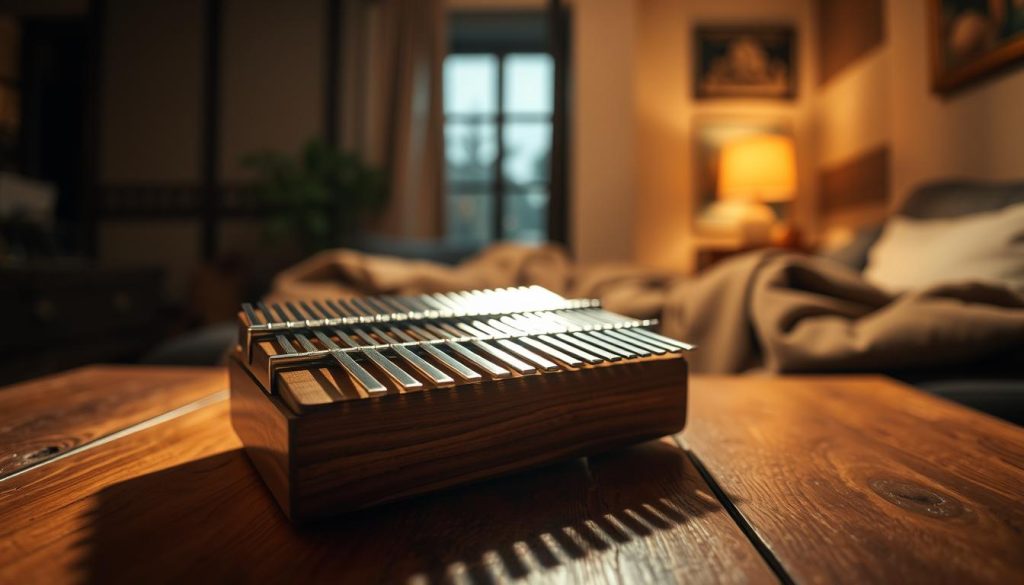
A kalimba’s volume depends in part on whether it has a resonator box. The instrument generally produces between 75 and 90 decibels, slightly louder than a normal conversation. It is therefore suitable for playing indoors without disturbing others and for performances before small groups.
There are two main types of kalimba: flat models without a resonator box and hollow models with one. Flat kalimbas have a quieter, more intimate sound. Hollow models produce a higher volume as sound waves are amplified in their cavity, and they allow for additional sound effects.
Kalimbas with and without resonator boxes: acoustic differences
Kalimbas with a resonator box amplify the tines’ vibrations. Their inner cavity and holes help transmit sound waves. These acoustic features make effects such as vibrato possible. Hollow models may also have extra holes to add further variety to their sound.
Built-in pickups on some models
Some kalimbas have built-in piezoelectric pickups, an interesting technical development. Mounted on the soundboard or inside the instrument, these pickups convert the tines’ vibrations into electrical signals. The signals can then be sent through a 6.35 mm jack to an amplifier, speaker, or audio recorder.
Piezoelectric pickups generate an electrical charge when they detect mechanical stress, such as a sound vibration. They give professional musicians more options for performing onstage, recording in a studio, or sharing their music on social media with high sound quality.
In short, technical developments allow the kalimba to meet modern needs while remaining connected to its African roots. Recent models provide a variety of sounds and effects that enrich the playing experience. To explore this fascinating instrument further, read this article.
| Kalimba type | Acoustic characteristics | Advantages |
|---|---|---|
| Flat models | Quiet, intimate sound | Portable and lightweight |
| Hollow models | Higher volume, more sound effects | Sound amplification, wah-wah and vibrato effects |
| Models with pickups | Convert vibrations into electrical signals | Ideal for performances and recordings |
Learning the kalimba and its uses today
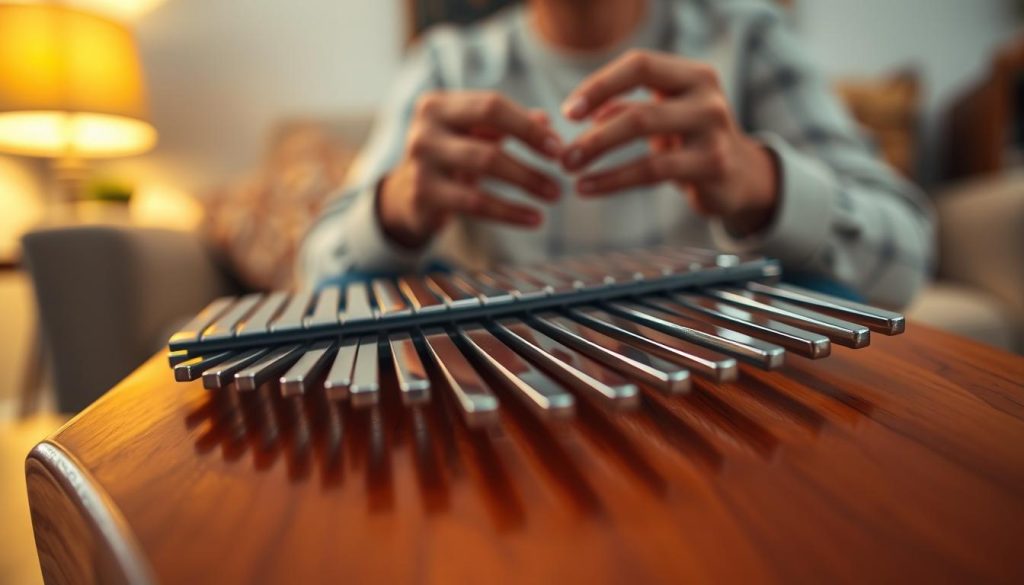
Learning to play the kalimba is a rewarding musical experience. The instrument suits beginners because it is easy to learn. The distinctive arrangement of its keys encourages a hands-on approach, making it easier to create complex music.
Reasons to learn the kalimba and its benefits
Here are six main reasons to learn to play this instrument:
- Hands-on understanding: the kalimba offers an intuitive approach to music.
- Creating melodies: it makes it easy to compose complex melodies.
- Simplicity: the instrument lends itself to meditation and relaxation.
- Quick progress: players can soon hear themselves improving.
- Inspiration: it encourages creativity and the creation of distinctive music.
- Portability: lightweight and inexpensive, it is easy to carry.
Learning tips for beginners
Here are some practical tips for getting started:
- Use a 17-key kalimba in C major, which is ideal for beginners.
- Hold the instrument with both hands, your thumbs over the keys and your other fingers interlaced behind it.
- Avoid covering the rear holes to preserve the sound quality.
- Pluck the tines with your thumbnails to produce clear notes.
- Alternate your thumbs to create melodies, and play chords by striking two adjacent tines.
- Check the tuning each week with a tuning hammer and a tuner.
- The basic notes in C major are C, D, E, F, G, A, and B.
- Experiment with melodies by combining notes and chords.
- With practice, calluses develop on the thumbs and make playing more comfortable.

The kalimba’s popularity and professional uses around the world
Over the years, the kalimba has grown popular worldwide. Many professional artists have embraced it, showing its musical versatility. Figures such as Maurice White of Earth, Wind and Fire, David Bowie, and April Yang have incorporated the kalimba into their music, demonstrating how it can fit different styles.
The kalimba is also used in music therapy. It can help improve movement coordination and stimulate memory. Its soothing sounds can support patients’ well-being and provide a way to relax.
In Europe, the kalimba is reaching an increasingly wide audience. Its small size, ease of learning, and gentle melodies appeal to people of different ages, from children to older adults. It has become a popular creative pastime at home and an educational tool for introducing young people to music.
The kalimba also has a rich cultural heritage. Its traditional predecessor, the mbira, was used by the Shona people at weddings and official ceremonies. It was also used to communicate with spirits and had a place in social life.
In 2020, the art of crafting and playing the mbira was inscribed on UNESCO’s list of intangible cultural heritage. This recognition highlights the historical and cultural importance of the instrument and its descendants, including the kalimba.
The kalimba’s growing presence on social media also contributes to its popularity. Many amateur and professional musicians share their performances on platforms such as YouTube and Instagram, introducing the instrument to audiences around the world.
In short, the kalimba continues to appeal to listeners and players. Its ease of use and ability to produce captivating melodies make it an ideal choice for aspiring musicians. To explore this fascinating instrument further, read this article.
Conclusion
The kalimba, a percussion instrument, has captivated music lovers since Hugh Tracey created it in the 1950s. Descended from the African mbira, it produces enchanting sounds when the thumbs set its steel tines vibrating. Its growing popularity stems from its small size, ease of learning, and soothing sounds.
With more than 200 models available in wood or acrylic, everyone can find a kalimba that suits them. Exploring the instrument opens up a rich musical world suited to meditation and music therapy.
For those who want to learn, many resources are available, from online tutorials to communities of enthusiasts. The instrument has a bright future, combining tradition and modernity while continuing to inspire new generations.