
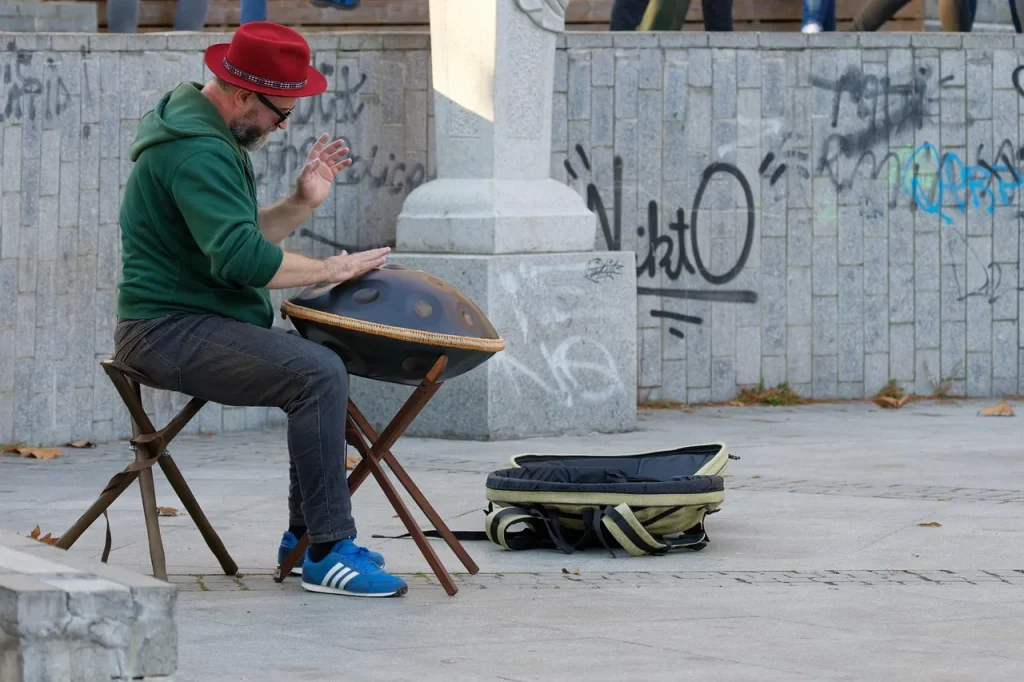
Introduction — This article traces the history of an instrument born in Bern, Switzerland, at PANArt Hangbau. It is the Hang, created by Felix Rohner and Sabina Schärer and inspired by the steelpan of Trinidad and Tobago.
The Hang was presented at Musikmesse in 2001 and quickly spread across the Internet. Its convex shape, resembling a lens, its central Ding and its tone fields defined a new category of musical instruments.
Handcrafted production, protection of the Hang name and the end of production in 2013 contributed to its scarcity and worldwide demand. The return announced in July 2024 at CHF 2,500 renewed discussion of the handpan’s origins and creators.
We will explain its Caribbean roots, the decision to favor craftsmanship amid growing demand, the terminology (Hang, handpan, pantam) and its impact on musicians. For a detailed overview, see this dedicated page.
What is the origin of the handpan?
A complete guide to the history and origins of an unusual percussion instrument
Born of extensive acoustic research, this instrument consists of two steel shells and tone fields sensitive to touch. It is an idiophone: each struck area produces a specific note.
Its creation combines tradition and innovation: tuning experiments led to stable instruments suited to improvisation and meditation. Playing it brings the fingers into direct contact with the surface.
The tuning places each instrument in a specific scale, providing a straightforward harmonic framework. Beginners quickly find their bearings, while advanced musicians explore the harmonics.
Its sound quality is characterized by a rich timbre and long resonance. Uses range from solo performance to accompaniment, soundscapes and wellness practices. The wider public appreciates both its accessibility and its expressive depth.
- Definition: two joined steel shells with tuned areas.
- Experience: tactile, intuitive and emotional playing.
- Uses: stage, studio and meditation.
| Feature | Benefit | Use |
|---|---|---|
| Two-shell structure | Sustained resonance | Solo performance, ambient music |
| Tuned areas | Immediate access to harmony | Improvisation |
| Precise construction | Stable harmonics | Concerts, meditation |
This guide covers the history of the handpan, its origins, tuning techniques and selection criteria. The following sections explore its Caribbean roots and the role of its principal creators.
From Caribbean roots to Asian influences: the handpan’s sonic foundations
Caribbean steel drums and Asian percussion instruments came together as influences that forged a new sound.
From the Trinidad and Tobago steelpan to a new instrument-making craft
The principle of hammered note areas, inherited from the steelpan, was adapted to this instrument played by hand. Its convex facets produce clear notes and gave rise to a new family of idiophones.
The inspiring role of the ghatam and hand percussion
In 1999, the introduction of a ghatam to Rohner and Schärer sparked an idea: a metal percussion vessel could offer greater durability and expressiveness than one made of clay.
Gongs, gamelan, tabla and bells: an alchemy
Gongs and gamelan contribute resonance, tabla contributes rhythmic articulation, and bells contribute clarity of overtones.

The discovery of nitrided steel (Pang) improved vibrational response, durability and tuning stability. Successive experiments led to a design made of two bonded convex shells. The coupling of their vibration modes makes it possible to arrange the tone fields in an arc, creating an intuitive scale.
This blend of influences gives the instrument a sound of its own. To explore its lineage and development further, see its origins and evolution.
Felix Rohner and Sabina Schärer in Bern: the birth of the Hang and Reto Weber’s spark
A conversation between craftspeople and a musician set its creation in motion in Bern. Felix Rohner and Sabina Schärer moved from making steelpans to exploring shape and tactile response.
In 1993, their workshop focused on steelpans. Then, in 1994, nitrided steel (Pang) improved stability. A 1999 visit from Reto Weber, with a metal ghatam, inspired the idea of an instrument played by hand.
From PANArt Steelpan Manufaktur to PANArt Hangbau
The organization changed: the workshop became PANArt Hangbau in 2003 to devote itself to the new creation. This shift reflected a strong commitment to craftsmanship.
1999–2001: prototypes and presentation
Between 1999 and 2001, prototypes established the central Ding surrounded by tone fields. The final design, developed in 2000, was presented at Musikmesse in 2001.
The reception was enthusiastic: the instrument sparked curiosity and was quickly adopted by musicians.
A distinctive sound and playing by hand
The shape formed by two convex shells optimizes wave propagation. Its timbre offers a clear balance between fundamental tones and overtones.
Its resonance is singing and the instrument responds to a light touch. Playing by hand allows subtle expression and close physical contact.
| Element | Impact | Key year |
|---|---|---|
| Nitrided steel (Pang) | Tuning stability and durability | 1994 |
| Central Ding & tone fields | Clear notes and sound structure | 2000 |
| Public presentation | International visibility and adoption | 2001 |
Ultimately, this instrument was invented by Felix Rohner and Sabina Schärer in 2000, the result of shared work and an idea born from an exchange with Reto Weber. For a broader chronology, see this overview of its history and evolution.
PANArt’s commitment to craftsmanship, worldwide demand and a change in distribution
Faced with worldwide demand, PANArt prioritized craftsmanship over mass production.
This decision was based on preserving sound quality and consistent tuning. The workshop limited its production rate so that it could refine each instrument.

Quality or quantity: waiting lists and control of resale
Around 2005–2006, PANArt ended its agreements with resellers. Prospective buyers then had to write a letter explaining their interest.
The company required a commitment against resale to discourage speculation. Waiting lists grew longer, and the instruments gained symbolic value.
After 2013: production ends, scarcity grows and a return comes in 2024
In 2013, the end of sales marked a turning point. PANArt’s withdrawal created room for other makers to meet demand.
The return announced in 2024 at CHF 2,500 confirms a selective approach: strict purchasing conditions and direct distribution by the workshop.
- Effect on the public: scarcity heightened desire.
- Impact on the industry: more instruments from other makers and a wider range of sounds.
- Effect on terminology: protection of the name encouraged use of a generic term for the entire family.
| Element | Decision | Consequence |
|---|---|---|
| Distribution | End reseller agreements; sell directly | Greater control and waiting lists |
| Policy against speculation | Letter of interest and commitment | Greater symbolic and economic value |
| Withdrawal in 2013 and return in 2024 | Stop production, then relaunch at a set price | Market opening and diversification |
This chapter of its history illustrates a familiar dilemma: remain a workshop faithful to its principles or meet growing international demand.
Origin of the handpan: from PANArt to the modern pantam
The vocabulary surrounding this instrument reflects both its history and the legal choices of its creators.
Hang is a trademark protected by PANArt Hangbau. For similar instruments, the community adopted the generic term “handpan” from 2007 onward.

Pantam, Spacedrum and other names
Makers use names such as pantam or Spacedrum to establish their identities. These names acknowledge a shared lineage while distinguishing one workshop from another.
- When to say “Hang”: when referring to the creation of Felix Rohner and Sabina Schärer or instruments made by PANArt Hangbau.
- When to say “handpan” or “hang drum”: when referring to the wider family of instruments.
| Name | Recommended use | Reason |
|---|---|---|
| “Hang” | Historical reference and PANArt product | Protected name; respect for the trademark |
| “handpan” / “hang drum” | Generic terms covering all makers | Clarity for the public and in sales |
| Pantam / Spacedrum | Workshop trade names | Distinctive sound and branding |
Respecting these naming choices protects the legacy of Rohner and Schärer and helps new players understand the instruments. When writing about them, be precise: use the brand name for the historical original and a generic term for the family of instruments.
Materials, shape and tuning: the craft of making a steel instrument
The combination of treated metal and carefully designed shape creates the instrument’s acoustic character.
Nitrided steel (Pang): introduced in 1994, this treatment increases hardness and helps the instrument hold its tuning. It supports sound projection and reduces deformation from playing.

Nitrided steel, two shells and tone fields
The construction combines two bonded convex shells, a central Ding and hammered, precisely tuned tone fields.
Each area produces a specific note through careful mechanical adjustment. The manufacturing process aims for stability and clear overtones.
Fine tuning, harmonics and scales
Tuning requires a trained ear: aligning the fundamental, octave and fifth limits unwanted interactions between notes.
Pentatonic or diatonic scales change the musical character and guide how the hand moves across the instrument.
Innovations and care
Recent developments include a double Gu for acoustic breathing, added bass notes and electronic versions that can change scales.
Regular care and retuning preserve sound quality and responsiveness. The maker balances stiffness and sensitivity to optimize resonance and articulation.
- Points of comparison: stability, overtone clarity and projection.
- Technique: periodic tuning and checking of harmonics.
From Bern to the rest of the world: growth, community and musical practices
Clips of concerts and street performances sparked interest in the instrument around the world, thanks to YouTube and social media.
Sharing performances online helped people discover it worldwide. Short videos and tutorials made learning more accessible.
On stage, it appears in intimate concerts and street performances, in studios and at meditation sessions. Its place in contemporary music continues to grow through soundscapes, acoustic and electronic fusions, and soundtracks.
Musicians appreciate its immediate expressiveness and ease of learning. Wellness practitioners cite relaxation, renewed focus and creativity among its practical benefits.
| Setting | Benefit | Example |
|---|---|---|
| Street / YouTube | Viral visibility | Hundreds of shared videos |
| Meditation / therapy | Calm and renewed focus | Workshops and guided sessions |
| Stages & studios | Sound colors for composition | Soundtracks, ambient music |
The international community is active: festivals, masterclasses and exchanges about instrument making help sustain this movement. To learn more, see the dedicated page describing these practices.
Makers and design approaches: from custom craftsmanship to carefully produced series
Meticulous workshops now coexist with brands that produce instruments in series. This range of makers offers varied designs, finishes and distinctive tuning styles.
Independent workshops and established brands
Tympan and Mayura embody the custom approach: long production times, finish options and prices reflecting complexity.
Sela, Metal Sounds and Battiloro produce larger series using rigorous methods and consistent quality control.
“A conversation with the maker often determines whether a musical project succeeds.”
Quality criteria include tuning stability, pitch accuracy, consistency across tone fields, projection and dynamic response. These factors guide the choice according to intended use: stage, studio or meditation.
- Manufacturing: hammering, stress relief, fine tuning and acoustic testing.
- Shape and variations: number of notes, single or double Gu opening, bass notes or electronic versions.
- Accessible alternative: the steel tongue drum, a related but simpler and less expensive instrument.
| Maker | Approach | Strength |
|---|---|---|
| Tympan / Mayura | Custom craftsmanship | Personalization, distinctive timbre |
| Sela / Metal Sounds / Battiloro | Carefully produced series | Availability, controlled prices, consistency |
| Steel tongue drum | Alternative | Accessibility, complementary sound |
Before buying, discuss your expectations with the maker. To discover makers and available options, see the page about makers and refine your choice.
Conclusion
Hands, steel and ideas transformed a Swiss workshop into a worldwide musical phenomenon.
Felix Rohner and Sabina Schärer, with input from Reto Weber, established the foundations: a lens shape, a central Ding and tuned notes. Their creation began the handpan’s journey around the world.
Manufacturing still involves choices between demanding craftsmanship and carefully controlled series. Sound quality depends on the steel, precise tuning and command of scales.
The protected name deserves respect, while the generic term provides clarity. Musicians, creators and instrument makers continue to write the next chapter. The 2024 return of PANArt Hangbau renewed debate, while performances and meditation confirm this percussion instrument’s place in contemporary music.