

The handpan’s dreamy tones captivate listeners around the world. This instrument turns familiar music into soulful versions by emphasizing melody, rhythm, and emotion.
Adapting a famous song means working within a limited number of notes and bringing its essentials to the fore. Imagine, Hallelujah, and Yesterday take on a meditative quality through warm resonance and an organic tone.
In this article, I’ll lay out a clear path: choosing a scale, following the steps of an arrangement, finding repertoire ideas, and using techniques to enrich the texture. The goal is simple: to give both the player and the listener an intimate, calming experience.
The desired result: each cover takes on a new dimension and reflects the player’s sensibility. Whether you’re curious or a musician looking for inspiration, the following advice will guide you step by step.
Why adapting popular songs for the handpan adds a new dimension
Turning a popular hit into an instrumental piece often reveals the song’s hidden soul. This new dimension emerges when the melody has more room to breathe and resonance sustains each note.
Resonance, emotion, and dreamy tones
Rich frequencies create an enveloping experience that heightens emotion. Warm tones and long resonance bring out melodic details that often go unnoticed.
When simplicity serves the melody
Stripping back the arrangement makes the melody clearer and more memorable. The natural dynamics of playing with bare hands then become a powerful means of expressing the song.
- Sound: an immersive quality that heightens emotional intensity.
- Clarity: fewer embellishments strengthen the main theme.
- Universal appeal: the approach works around the world and connects with all kinds of listeners.
In short, the instrument’s strength lies as much in its tone as in the space it leaves for the melody, creating a deep and calming musical experience.
Handpan covers: how to adapt well-known songs
Start by identifying the fragments that make a song instantly recognizable. Isolate the chorus, main motif, or a distinctive riff. This step makes the arrangement easier and helps guide your choice of scale.

Identify the melodic and rhythmic essence
Find the main melody and the cues that shape the rhythm. For a complex song, focus on the transitions and passages that stand out to listeners.
Balance simplicity and complexity to suit the song
A limited number of notes forces you to make choices. Simplify the melodic line while preserving the character of the theme. Use ostinatos or light arpeggios to support it without obscuring it.
Capture emotion through tone and dynamics
Choose the essential scale degrees: every note should contribute to the song’s identity. Work on gentle attacks, carefully placed accents, and changes in intensity. Test your arrangement by ear, adjust it, and write it down if needed.
- Priorities: iconic introduction, chorus, bridge.
- Method: experiment and adjust to find the right level of complexity.
- Goal: an authentic, personal creation.
This approach encourages creativity and an interpretation that stays true to the spirit of the song. The result highlights the melody.
Choose a scale and tuning for successful covers
Your choice of scale guides the tuning and shapes the entire performance. It determines which notes are available and how easily you can make a melody recognizable.
D Kurd and other common options
D Kurd is widespread for good reason: it offers a rich range of scale degrees and makes many popular music themes accessible. Modern tutorials provide an immersive view and intuitive notation. This speeds up learning on most instruments with a central note and notes arranged around it.
Match the original key to your instrument’s range
Map the original key onto your instrument’s range to identify missing notes. If a note is unavailable, you have three options: transpose, substitute the note, or simplify the passage.
| Problem | Solution | When to use it |
|---|---|---|
| Target note unavailable | Transposition | When the whole song remains within a comfortable range |
| Note difficult to replace | Substitute a nearby note | To preserve the harmony without adding complexity |
| Busy passage | Rhythmic simplification | To retain the essence of the melody |
Tip: choose a tuning based on the repertoire you want to play and the number of notes you need. Listen to demonstrations in different scales to refine your choice by ear.
Key steps for reinventing a famous melody on the handpan
Reinventing a familiar theme begins with listening closely to every detail. An active listening routine helps you isolate the motif, identify the pulse, and mark the musical breathing points.
Listen actively, find the key sections, and simplify
Focus first on the chorus and main motif. Isolate these sections and play them slowly.
Remove unnecessary embellishments: every note should contribute to the song’s identity.
Work on tempo: from a slow pace to the original speed
Start slowly with a metronome. Increase the tempo in stages to master the transitions.
This steadies your movements and improves your control of dynamics. The time you spend practicing directly affects the quality of your performance.
Check it by ear before writing it down
Try several versions and choose the one that balances clarity and emotion. Listen to it once or twice to confirm your choice before writing it down.
Add a personal touch without losing the original
Adding an accompaniment pattern or a slight rhythmic variation is often enough. This touch preserves the song’s melodic identity and encourages creativity.
- Tips for beginners: start simply and practice in short daily sessions to learn to play the handpan.
- Try different tunings and draw inspiration from artists to develop your arrangement.
Song ideas that work beautifully on the handpan
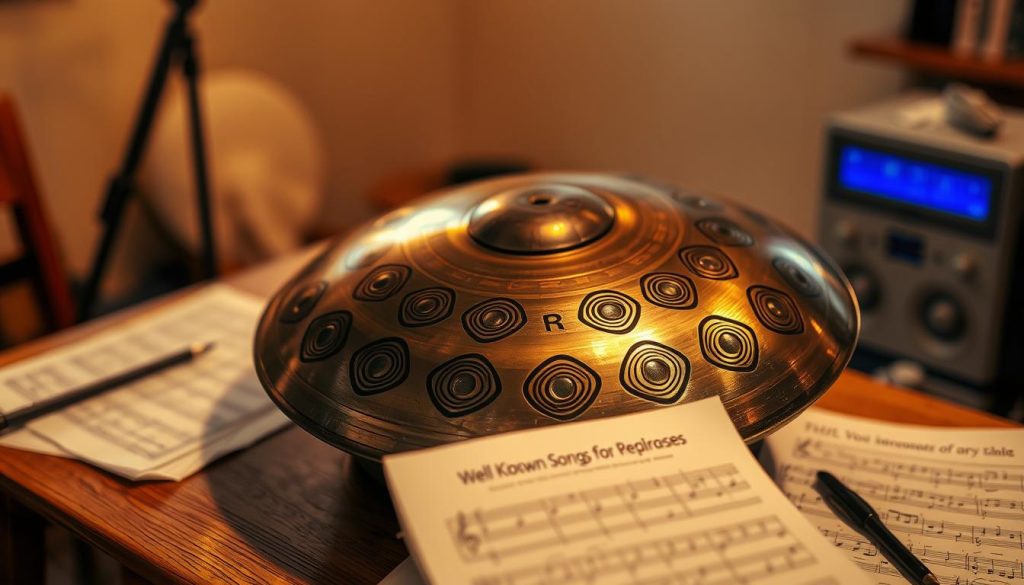
The best choices often start with simple, strong motifs. Choose instantly recognizable themes to capture attention and make learning easier.
Comforting classics
Imagine, Hallelujah, Yesterday, and Let It Be are ideal. These pieces offer easy-to-sing melodies and clear harmonic progressions.
Epic and cinematic themes
Pirates of the Caribbean, Interstellar, and Game of Thrones let you work on building intensity. Their structures help you create dramatic textures.
Pop songs and modern ballads
A Thousand Years and Shape of You are good choices for exploring ostinatos and creative repetition of motifs. This repertoire is ideal for inventing simple accompaniments.
Iconic rock songs
Bohemian Rhapsody, Stairway to Heaven, and Nothing Else Matters are useful for learning to condense sections while preserving the spirit of each song.
- Start with songs that are easiest to sing, such as Imagine and Hallelujah.
- Watch several performance recordings to reproduce the movements and dynamics.
- Build a reference playlist and compare approaches from around the world.
Getting started step by step: a practice plan for your first cover
The key to a successful first cover lies more in your method than in how hard you practice. Follow a simple, gradual routine to stay motivated.

Here is an easy weekly plan: 20 to 30 minutes a day, five days a week. Alternate between listening, working out the notes, and reinforcing what you have learned to make steady progress.
Practice the melody on its own first, then add a light accompaniment pattern. Divide the song into short sections and repeat each part several times before joining them together.
- Choose recordings filmed from above so you can copy the movements without reversing them.
- Record your attempts to assess the rhythm and dynamics.
- Use a metronome and raise the tempo in stages; always finish slowly to reinforce what you have learned.
Modern platforms offer filmed lessons, intuitive notation, an ebook available offline, and progress tracking synced across devices. These tools help musicians stay motivated through community support, challenges, and coaching.
| Goal | Duration | Action |
|---|---|---|
| Active listening | 5 to 7 min | Identify the main motif |
| Working out the notes | 10 to 15 min | Play the melody on its own |
| Reinforcement | 5 to 8 min | Add a light accompaniment |
Keep your hands relaxed: every note should ring freely, without striking too hard. With regular practice and, of course, patience, fluency comes naturally.
Techniques to enrich your covers: rhythms, harmonies, and textures
Subtle layers of accompaniment give the melody more room to breathe. Working with arpeggios and ostinatos lets you support the theme without obscuring it.
Arpeggios, ostinatos, and recurring patterns
Build a gentle ostinato with low notes to anchor the rhythm. This creates a stable foundation on which melodies can unfold.
Arpeggios suggest the harmony without weighing down the arrangement. Play them slowly, then simplify them until you find the right balance.

Ghost notes, dynamics, and expressive playing
Introduce ghost notes to create a subtle pulse. They add movement without making the arrangement feel heavy.
- Vary the dynamics: play pianissimo to convey restraint, then add carefully placed accents.
- Use silence: a well-placed pause adds an expressive dimension and lets the music breathe.
- Bring the elements together step by step: ostinato → arpeggio → ghost notes → dynamics.
Record a reference version to check the balance between the accompaniment and the melody. Methodical practice expands your technical vocabulary and serves the emotion of the piece.
Resources to learn and make progress quickly
To progress quickly, choose structured, visual resources that guide you through each step.
Recommended courses and masterclasses
MasterTheHandpan offers an immersive overhead view, color-coded notation, and an ebook available offline. Its Unlimited Pass provides access to dozens of masterclasses (Hang Massive, Kabeção, Manu Delago), as well as live workshops and coaching.
Immersive lessons and practical materials
Recordings filmed from above make it easier to understand the movements. Ebooks let you practice without an internet connection and maintain a clear routine.
Community, challenges, and support
Joining a community brings feedback and motivation. Monthly challenges and workshops help musicians maintain momentum and enrich their musical lives.
- Choice: compare options based on your budget, style, and goals.
- Price: consult the “2025 Price and Budget” guides to plan your purchase.
- Bonus: look out for announced masterclasses (for example, Hang Massive) and competitions offering a chance to win an instrument.
Choosing an instrument for covers: options, prices, and criteria
Your purchase decision should account for the number of notes, resonance, and portability. These three factors determine playing comfort and musical sound.
Number of notes, resonance, and practicality
The number of notes affects your repertoire: nine notes are enough for simple themes, while 11 to 13 notes open up more melodic possibilities. More notes require greater precision.
Resonance should be balanced. A controlled sustain supports the melody without creating a harmonic blur.
Compact pantams provide access to high notes, welcome portability, and surprising depth for playing on the move.
Budget and value for money
Consult the “Handpan Prices and Budgets: 2025” guides before buying. Compare entry-level models, high-end handmade instruments, and midrange models.
Tip: listen to demonstrations through headphones and speakers to judge the tone before deciding whether the price is right.
Compatibility and access to high notes
Courses and teaching methods are often compatible with steel tongue drums. This can make your choice easier based on your budget and intended use.
| Criterion | Impact | Recommendation |
|---|---|---|
| Number of notes | Possible repertoire | 9 for beginners, 11 to 13 for more options |
| Resonance | Sustain and clarity | Choose balanced resonance without excess |
| Price | Quality and budget | Compare stores, demonstrations, and warranties |
| Finish and color | Personal connection | Choose what appeals to you; no effect on sound |
The best choice takes account of your budget, long-term goals, and the musical life you envision. Listen to plenty of models, try them, and choose the instrument that inspires you.
Conclusion
In conclusion, a sincere performance brings out the soul of the theme you have chosen. Identify the essential melody, choose a suitable scale, respect the rhythm, and work on your dynamics. Give each note care to preserve clarity.
Practice by returning often to the same sections: time develops accuracy and a personal touch. Build a small, coherent repertoire of covers to gain confidence and create a rewarding musical experience.
Choose your courses, try different learning options, and refine your purchase based on price, tone, and the number of notes. Finally, pick a song you love, set a slow tempo, and play the handpan today to enjoy music right away.