
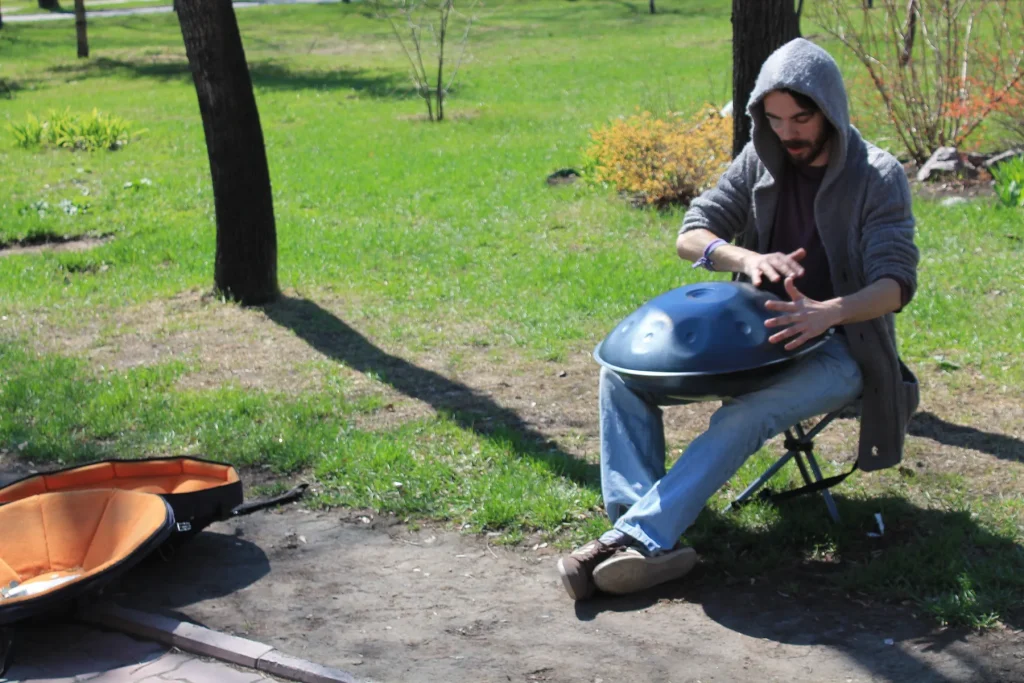
Goal: this guide offers practical ways to master the instrument, from posture to the movements that shape its sound.
The handpan is a percussion instrument made from two hammered steel shells. It offers tuned notes and rich harmonics. Regular practice, even in short sessions, builds muscle memory and sharpens your listening.
This guide follows a gradual path: fundamentals, hand placement, contact points (edge, ding and shoulder), then more advanced effects. Finesse matters most: light, precise strikes produce clear sounds.
To improve, combine online courses, lessons with a teacher and independent practice supported by visual notation. To get started, consult a practical resource on learning to play the handpan.
Coming up: advice on tempo, sustain and advanced variations to enrich your music and playing experience.
Why technique matters on this percussion instrument
A solid technical foundation helps you bring out every nuance of this percussion instrument. A precise touch produces clear tones, controlled sustain and a clean attack. It also helps you create varied sounds without excessive force.
Good striking technique prevents inefficient habits, such as hitting too hard or tensing up. Proper movement protects the instrument and improves fluidity when playing alone or with others. Practising scales and patterns sharpens your ear and pitch awareness.
Good instruction develops expression and musical experience. A teacher’s tailored advice helps players correct small faults. Good posture, flexible wrists and relaxed shoulders improve endurance.
| Benefit | Immediate effect | Recommended practice |
|---|---|---|
| Precise touch | Clean attack, fewer unwanted noises | Slow exercises with a metronome |
| Dynamic control | Shaped sustain, better tone | Varying intensity within each phrase |
| Posture and relaxation | Less fatigue, more efficient strikes | Stretching and regular breaks |
Conclusion: working on technique early speeds up progress. It provides a firm foundation for exploring different styles and repertoires.
How to hold the handpan: posture and hand placement
A stable position makes a real difference to sound quality and playing comfort. Sit on a low chair, such as a camping chair, so your knees stay slightly above your hips.
Rest the instrument on your thighs, tilted toward your torso. This slight angle steadies it and makes the tone fields easier to see.

Seated position and support
Resting the instrument on your thighs without pressing down preserves its resonance. Avoid unnecessary contact with clothing or your torso, which can absorb vibrations.
Scale orientation
Place the lower notes near your torso to limit body movement. This lets you move between tone fields without changing your posture.
Flexible wrists, relaxed fingers
Keep your hands above the surface, with your fingers slightly curved. Your wrists should remain flexible to deliver short, precise bursts of energy.
- Practical test: play a full scale without moving your torso, adjusting only the angle of your hands.
- This posture reduces fatigue and improves consistency during longer sessions.
- Adjust your seat height and the instrument’s tilt to find the most natural playing position for you.
Producing clear sounds: basic striking techniques
A clear sound comes from brief, precise contact with the surface. The main movement is a quick, light touch with the fingertip, driven by the wrist.
Where to strike: the edge between the tone field and its dimple is the best contact point for most notes. Strike the ding near its centre; use the shoulder for drier percussion sounds.
Use your thumb for nearby notes and your index and middle fingers for the others. Aim for precision instead of force to protect the instrument and your hearing.
Controlling sustain changes your phrasing: letting notes ring creates an airy texture. Brief, muted contact articulates the rhythm and creates accents.
- Coordinate your wrist movement and finger release to avoid unwanted rubbing sounds.
- Play each note three times, alternating left and right hands to even out tone and volume.
- Move slightly around the edge until you find each note’s sweet spot.
Suggested exercise: play slowly with a metronome. Isolate one note, then repeat it with legato phrasing and separate attacks. Clarity comes from precision, not intensity.
Handpan playing techniques: strikes, ghost notes and dynamics
Control of touch lets you shape precise, natural musical phrases.
Controlled strikes: measured intensity, a short attack and immediate release. This movement produces clean, distinct sounds within the instrument’s overall resonance. Focus on the speed of the attack rather than force.
Ghost notes between accents: place these very light strikes between the beats to add rhythmic density without increasing the volume. Use a metronome to time them precisely.

Dynamic variation: move from pianissimo to mezzo-forte by changing the speed of contact. A subtle slap on the area between tone fields can mark the end of a phrase without sounding harsh.
“Musicality comes from the balance between silence, accents and ghost notes.”
- Exercise: play a simple pattern and insert ghost notes on the offbeats while keeping a steady tempo.
- Alternate hands to distribute the accents and maintain an even tone.
- Record yourself to check the balance between main notes, ghost notes and slaps.
| Element | Purpose | Practical tip |
|---|---|---|
| Controlled strike | Clarity and definition | Short attack, immediate release |
| Ghost notes | Add depth to the groove | Place them between beats with a metronome |
| Light slap | Occasional accent | Use the areas between tone fields and control the intensity |
Final tip: listen to experienced players and use learning resources to refine your rhythmic placement, such as a method for composing calming music.
Rhythm, tempo and hand independence
Establishing a steady pulse is the key to fluid grooves. Practising with a metronome stabilizes your tempo and prevents unconscious speeding up.

Metronome, foot tapping and consistency
Start slowly and tap the pulse with your foot. Your foot gives you a reference point for placing accents.
Tip: synchronize your foot with the metronome click before adding patterns.
Simple alternating patterns to establish a groove
Begin by alternating your right and left hands. Then gradually add accents and syncopation.
- Vary the subdivisions: quarter notes, eighth notes and triplets will broaden your vocabulary.
- A few minutes of daily practice, adding up to many hours over time, improves muscle memory.
- Follow structured methods or lessons to introduce more complex patterns gradually.
- Exercise: play a simple pattern with your right hand and a clave rhythm with your left; then reverse the roles.
“Rhythmic precision makes the music easier to follow and strengthens the flow the listener feels.”
Final tip: record yourself to check the steadiness of your tempo and the evenness of your strikes. Players improve quickly with a regular, guided routine.
Advanced techniques and effects to expand your sound
Advanced effects expand your range of sounds and turn a simple melody into a musical landscape.
The slap, tak and palm mute add colour to a phrase and punctuate a transition. Play a slap with the flat of your fingers on the area between tone fields. A tak targets the edge between the shoulder and that area to produce a crisp strike. A palm mute dampens the ding’s resonance with your palm to produce a low, muffled sound.

Fist and knock strikes provide occasional percussion accents. Use the base of your fist or a knuckle very sparingly to avoid deforming the instrument or affecting its tuning.
Vibrato, slides and rolls
Vibrato comes from a slight oscillation of the hand or a finger glide. Slides connect sounds and create smooth transitions.
Finger rolls and thumb rolls produce rapid trills. Use two or three fingers in succession, or roll your thumb, to create a bed of sound without interrupting the melody.
- Musical use: add colour and punctuation, and produce contrasting sounds without obscuring the main line.
- Precautions: limit the force of fist and knock strikes to protect the instrument.
- Example: play a simple melodic pattern, add a tak on an offbeat, then finish the measure with a palm mute.
“Effects should support the musical idea, not overwhelm it.”
Practise each effect slowly and locate its point of impact before increasing your speed. Vary its placement and intensity for an introduction, accent or return to a phrase as you develop your style.
Practical exercises, notation and learning routines
Short, regular routines build muscle memory more effectively than a single long session.
Warm-up: strike each tone field five times, alternating hands. Aim for even tone and volume.
Ascending and descending the scale
Play the scale from low to high, then in reverse. Practise with a metronome to develop your ear and pitch awareness.
Increase the tempo gradually until the movement becomes automatic. Loop short sequences to build muscle memory.
Chords, patterns and rhythmic variations
Lightly strike two or three compatible notes, depending on the tuning, to create simple chords.
Build a basic pattern, then vary its accents or subdivisions to enrich the groove.
Daily routine
- 5 minutes of striking technique as a warm-up.
- 5 minutes of scales and chords to work on the instrument’s scale.
- 5 minutes of rhythmic patterns and variations.
- 5 minutes of improvisation and listening, with a recording for self-assessment.
Visual notation: use overhead-view tablature and two-line notation, one line for each hand, to organize your movements and develop hand independence.
| Goal | Duration | Tip |
|---|---|---|
| Technique | 5 min | Warm-up: 5 strikes per note |
| Structure | 5 min | Scales and chords with a metronome |
| Creativity | 10 min | Patterns, improvisation, recording |
Follow courses, videos and established methods to correct your movements. Time your sessions to make the most of your time. As these short sessions add up to many hours, they produce lasting results in learning and practice.
Common mistakes and ways to improve in France
Recognizing common faults helps you adjust your practice and avoid bad habits.
Common mistakes: striking too hard, tense hands, unstable posture, inconsistent practice and a lack of structure.
Practical tips: use less force, relax your shoulders and wrists, and slow down to correct your movement. Practise with a metronome and divide your practice into shorter sessions.
Online courses, such as those from MasterTheHandpan, provide a progressive structure with visual lessons and graded exercises.
For personalized feedback, consider private teachers through Superprof: a teacher can spot faults quickly and help you learn faster.
- Free videos and tablature help you see the movements and memorize patterns.
- Join French and international handpan communities to share experiences and stay motivated.
- Make a considered choice of resources based on your time and budget.
Adopt a gentle discipline: short, frequent sessions work best. Set one small goal each week, such as posture, a scale or a pattern, and assess your progress.
Conclusion: combining courses, teachers, videos and local learning resources makes learning this instrument safer and more enjoyable.
Conclusion
Develop your style through discipline, curiosity and the pleasure of playing.
Posture, hand placement and light strikes remain the foundations of a clear handpan sound. Rhythm and tempo shape each phrase and help you produce expressive sounds.
Establish a simple routine with suitable notation, measurable goals and short, regular sessions. Listen to yourself, make recordings and adjust your playing to enrich your musical experience.
Combine fundamental movements with advanced effects to create a personal signature. Use this article as a roadmap for the coming weeks.
Consistency and curiosity gradually turn technique into living music.