

Choosing between an instrument with a chromatic scale and a diatonic model is an important decision for any musician. It depends mainly on the player’s expectations and goals. Although a chromatic model is more expensive and heavier, it offers greater musical possibilities.
The chromatic scale has 12 notes per octave, compared with just 7 in a diatonic scale. It makes it possible to play more complex and refined melodies. This choice can shape a musician’s development.
In this article, we will explore the technical differences, advantages and disadvantages of each type of kalimba, along with tips for improving. The aim is to help you make an informed choice about the right kalimba for you.
Whether you are a beginner or an experienced musician, this guide will explain the options available on the French market. Read on to find out which instrument best suits your needs.
Introduction: understanding the kalimba and its scales
The kalimba, also known as a thumb piano, is a fascinating instrument with African roots. It is also called a mbira or sanza. This instrument consists of metal tines mounted on a resonator. Musicians pluck the tines with their thumbs to produce melodic sounds.
To better appreciate this instrument, it helps to understand the two main scales: diatonic and chromatic. The first consists of 7 natural notes: C, D, E, F, G, A and B. These notes repeat across several octaves, providing a rich range of sounds.
The chromatic scale expands that range by adding 5 altered notes, called sharps and flats. This brings the total to 12 notes per octave. The distinction matters to musicians who want to explore more complex melodies.
It is also worth noting that, in the tonal system, there is no B sharp or C flat, which affects how the notes are played. This detail is fundamental for anyone choosing a chromatic model.
The choice of scale matters. It determines which pieces a player can perform. For example, a standard 17-tine diatonic kalimba covers about two and a half octaves of natural notes, while a chromatic model offers greater flexibility.
To make these differences clearer, here is a comparison of the two types of kalimba:
| Features | Diatonic kalimba | Chromatic kalimba |
|---|---|---|
| Number of notes | 17 natural notes | 12 notes (7 natural + 5 altered) |
| Scale | Diatonic scale | Chromatic scale |
| Musical complexity | Less complex | More complex |
| Range of melodies | Limited | Broader |
Choosing between these two models has a considerable effect on the playing experience. Understanding scales and how they work helps any musician get the most from their instrument.
To learn more about the diatonic kalimba, read this article here. To discover other similar instruments, follow this link.
Chromatic or diatonic kalimba: what are the musical and technical differences?
Understanding the differences between these two types of instrument is useful for any musician. Their range of sounds and expressive possibilities differ considerably between a 7-note model and a 12-note model. This section explains their technical and musical differences.
Notes and scales: the difference between 7 and 12 notes
An instrument with a diatonic scale offers only 7 notes per octave, while its chromatic counterpart offers 12. This allows the chromatic kalimba to include altered notes such as sharps and flats. These notes expand the musical vocabulary and provide greater flexibility when playing pieces.
Number and arrangement of tines
A standard diatonic kalimba has a single row of 17 tines. Chromatic models generally have two rows, with an average of 34 tines in total; some have as many as 42. The lower row of these instruments often follows the layout of a diatonic kalimba, while the upper row contains the altered notes.
Effects on sound and musical variety
The ability to play more complex melodies is a major advantage of the chromatic kalimba. For example, a chromatic kalimba is essential for playing Beethoven’s “Für Elise” in its original form. Diatonic adaptations replace altered notes with natural notes, limiting the richness of the sound.
Here is a comparison of the musical and technical features of the two types of instrument:
| Features | Diatonic kalimba | Chromatic kalimba |
|---|---|---|
| Number of notes | 7 notes | 12 notes (7 natural + 5 altered) |
| Tine arrangement | 1 row of 17 tines | 2 rows with 34 to 42 tines |
| Musical complexity | Less complex | More complex |
| Range of melodies | Limited | Broader |
Choosing between these instruments greatly affects the playing experience. With its extra notes and two rows of tines, the chromatic model offers greater versatility and more musical possibilities. To explore the subject further, read this article on the differences between the models.
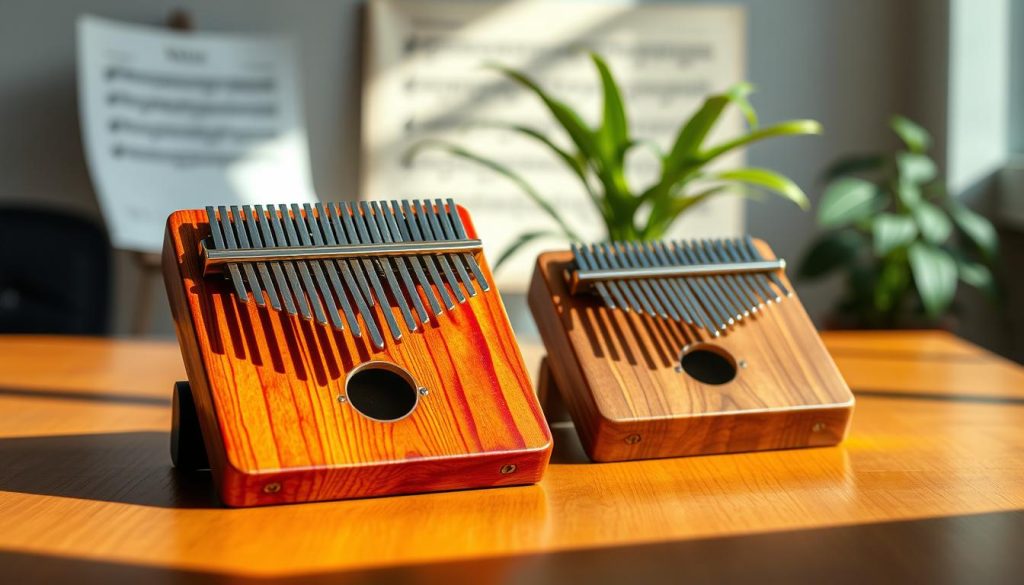
Advantages and disadvantages of chromatic and diatonic kalimbas
Understanding the strengths and limitations of each instrument can help guide your choice. Each type of kalimba has features that may affect the playing experience.
Strengths and limitations of the diatonic kalimba
The diatonic kalimba is valued for its light weight: it weighs about 400 grams. This makes it easy to handle, even for children. Its ease of use makes it an excellent choice for beginners.
There is a wide variety of models, with or without a resonator, made from different materials. Musicians can therefore find an instrument that suits their preferences.
This model does have some limitations, however. It does not offer semitones, which can restrict the pieces you can play. Experienced musicians may also find it frustrating to retune certain tines to obtain altered notes.
Advantages and constraints of the chromatic kalimba
The chromatic kalimba offers extensive musical possibilities. Musicians can play more complex melodies without retuning the tines. It is an instrument that can grow with a beginner, who can focus on the lower row first and progress from there.
Despite its advantages, the chromatic kalimba has drawbacks. Its price is generally higher, ranging from 100 to 200 euros, while diatonic models start at 50 euros. It also weighs between 600 and 700 grams, making it less convenient to carry.
Comparing ease of use, price, weight and resonators
The diatonic kalimba is easier to handle because it is lighter and simpler. Although heavier, the chromatic kalimba offers a wider variety of tones.
Diatonic models often have a resonator, while chromatic models rarely do. Without one, sound effects such as vibrato and wah-wah are more limited.
Finally, according to observations reported by makers such as Poopoopidoo, 80% of diatonic kalimba players eventually want to switch to a chromatic model.
How do you choose between a chromatic and a diatonic kalimba?
Choosing the right instrument starts with defining your expectations and musical goals. The differences between models can have a considerable effect on your playing experience.
Define your expectations and musical goals
Before choosing, ask yourself these questions:
- Do you want to play simple melodies or compose more complex pieces?
- Are you a beginner, or do you already have musical experience?
- Is your aim to meditate or to play covers?
The diatonic model is often recommended for beginners because of its simplicity. It also suits children and older people. If you are already a musician and want to compose or play without retuning your instrument, the chromatic model is the better choice.
Practical considerations: budget, ergonomics and portability
Budget is an important consideration. Diatonic models are generally more affordable, with prices below €50. Chromatic kalimbas cost between €100 and €200 but may be a better long-term investment.
In terms of ergonomics, the diatonic model is lighter: it weighs about 400 grams, compared with 600 to 700 grams for the chromatic model. It is therefore easier to carry, especially on walks in the forest or mountains.
How material and the resonator affect the instrument
The material also affects sound quality. Chromatic kalimbas are mainly made of wood, which gives them a rich sound. Diatonic models are also available in acrylic, a material that can change the tone.
The resonator is another factor to consider. Most chromatic kalimbas do not have one, whereas diatonic models often do. It amplifies the sound and adds effects such as vibrato.
Available tunings, such as C, B, G, F-sharp, F and E, also affect the tone and the feel of the music. For people with anxiety or who are neurodivergent, lower tunings and warm tones without a metallic sound are recommended.
If you are undecided, a two-in-one chromatic model with two rows may be ideal. You can begin by playing diatonically, then use the upper chromatic row.
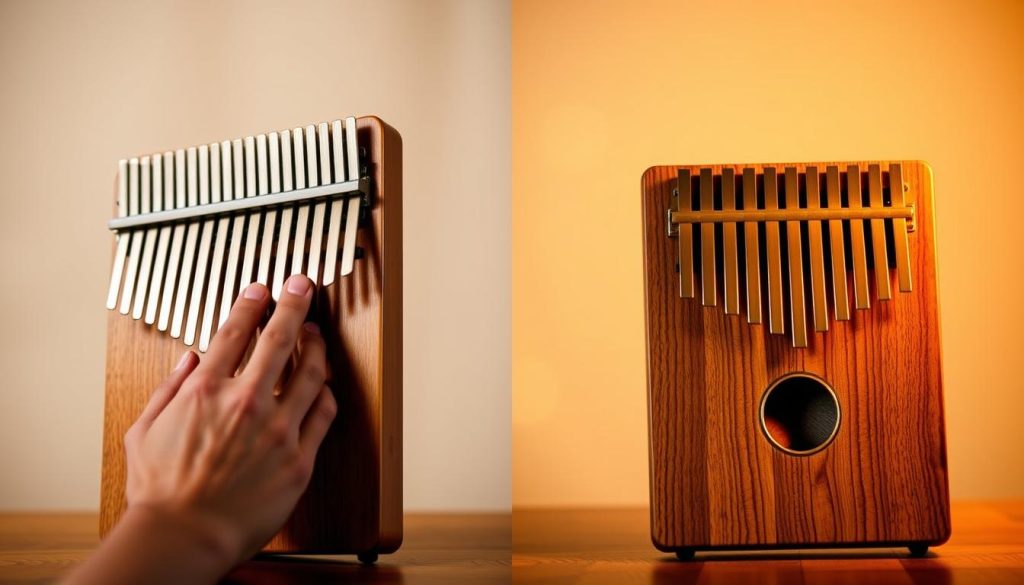
Tips for improving with a chromatic or diatonic kalimba
To get the most from your tine instrument, adapt your learning to your level. Every musician has different needs, and a tailored approach can make progress easier.
Match the difficulty to your starting level
Beginners are advised to start with simple pieces. This helps them become familiar with the notes and how to handle the tines. A diatonic kalimba or the lower row of a chromatic model makes this stage easier. You can play songs in C major without altered notes, making learning more accessible.
Gradually use the rows of a chromatic kalimba
A 34-tine model lets you start with the lower row, which resembles a diatonic kalimba. Once you feel comfortable, you can add the tines in the upper row. This lets you explore more complex melodies at your own pace.
Recommendations for beginners and experienced musicians
For experienced musicians, exploring nonredundant tunings is an excellent way to broaden your repertoire. Models such as those made by Poopoopidoo let you experiment with different ranges. Sound effects such as vibrato can also enrich your playing, especially on models with a resonator.
Joining online communities to share tablature and tips, and to learn from other musicians, is also recommended. Regular practice is essential for developing muscle memory and thumb dexterity.
Here is a summary of tips for improving:
| Tips | Beginners | Experienced musicians |
|---|---|---|
| Getting started | A diatonic kalimba or the lower row of a chromatic one | Explore complex pieces with altered notes |
| Learning method | Master the 17 tines in the natural-note row | Use nonredundant tunings |
| Recommended pieces | Songs in C major | Transpose melodies to suit the instrument |
| Why practice matters | Practice regularly to develop muscle memory | Use sound effects to enrich your playing |
Whether you are a beginner or an experienced musician, choose a learning method that suits your level. To learn more about this instrument and how to play it, read this article on kalimbas.

Conclusion: finding the right kalimba for your music
Choosing the right instrument for your music is an important step. The choice between a 7-note and a 12-note model depends on your expectations, budget and musical experience.
The 7-note model is ideal for people seeking simplicity. It is well suited to meditative playing or young musicians. If you want to play more complex melodies, the 12-note model will suit you better.
Two-in-one models that combine both scales offer an appealing option for anyone who is undecided. They let you start with simple melodies before moving on to more elaborate compositions.
Take time to explore the available options. Makers such as Poopoopidoo offer quality kalimbas for different needs. Above all, enjoy playing and exploring the fascinating world of this instrument.